Loading…
The Language of Life (Part 4): 'Dreaming Up' Antibodies—Generative AI for Biologics
By Ryan Wentzel
3 Min. Read#Drug Discovery & Biology#antibody-design#biologics#CDR-design#developability
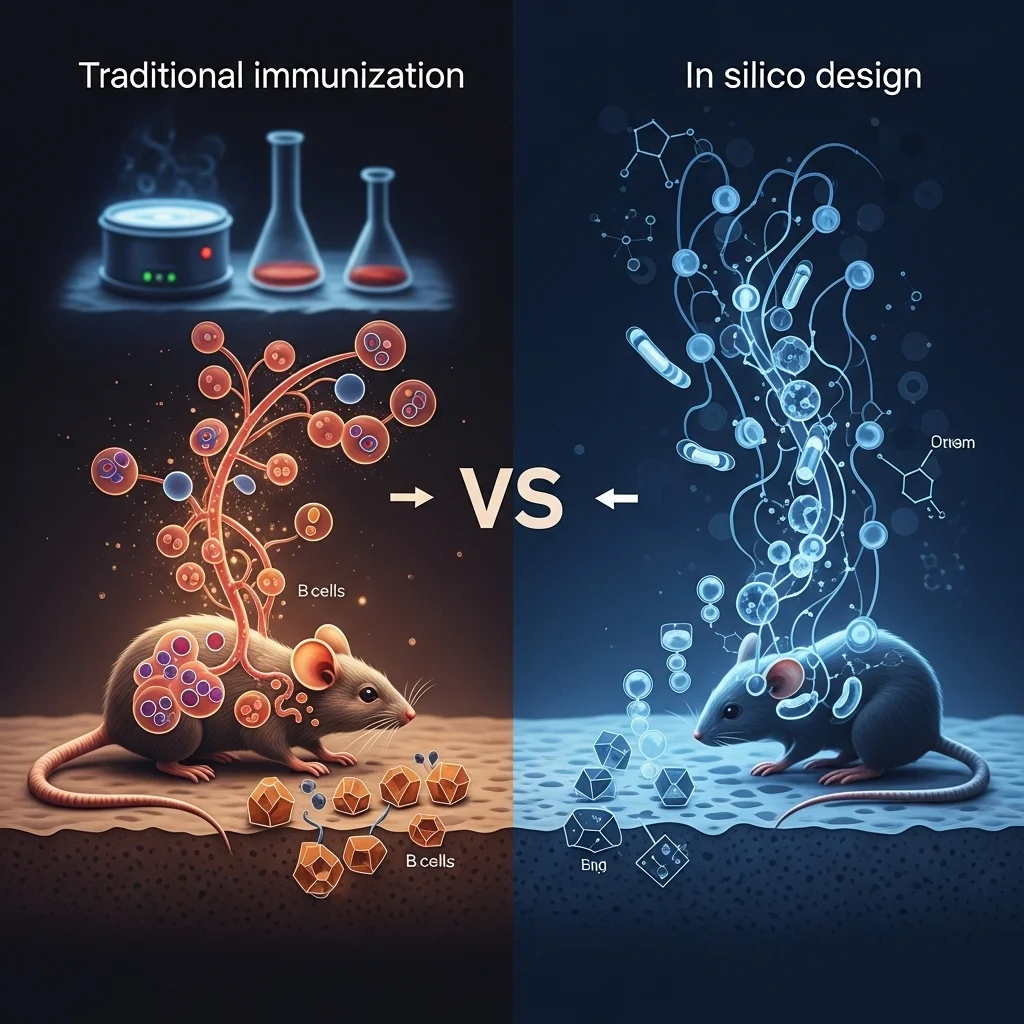
Table of Contents
- The Biologics Challenge: Beyond Small Molecules
- Humanome.ai's In Silico Biologics Design
- The Real Challenge: "Developability"
- Co-Generation of Binding and Developability
- Conclusion
The Biologics Challenge: Beyond Small Molecules
We have covered de novo proteins (Part 2) and de novo small molecules (Part 3). Now we turn to biologics—specifically, therapeutic antibodies.
Antibodies are the fastest-growing and one of the most effective classes of drugs, valued for their exquisite specificity. But as any biologics team knows, they are "messy". They are massive, complex proteins.
The "Old Way" of discovering them is slow, expensive, and analog:
- Immunization: Discovering them in mice and then "humanizing" them
- Library Screening: Screening vast phage display libraries
Both methods are resource-intensive. Worse, the "humanization" process—grafting the mouse-derived binding loops (CDRs) onto a human scaffold—is a "patch." It is a slow, error-prone process that often fails, resulting in candidates with high immunogenicity (the tendency to be rejected by the human immune system).
Humanome.ai's In Silico Biologics Design
Humanome.ai's approach is designed to skip this entire messy process, designing de novo antibodies in two stages, entirely in silico.
Stage 1: Designing the "Business End" (CDRs)
An antibody's binding specificity is defined by its six Complementarity-Determining Region (CDR) loops. The target's binding surface is the "epitope."
Using the 3D structure of our target epitope (the "lock"), we use our generative models (from Part 2, such as RFdiffusion or SOTA binder-design models like OriginFlow) to de novo design CDRs that are a perfect complementary match.
This single in-silico step can generate a library of 10^6 or more antibody variants, all specifically "dreamed up" to bind the target epitope.
The Real Challenge: "Developability"
This is the central problem in biologics. A perfect binder is not a drug. The primary reason biologics fail in development is "poor developability".
We define "Developability" as a set of critical, non-negotiable biophysical properties:
- Low Immunogenicity: Does it look "foreign" to the human immune system?
- High Solubility: Will it aggregate (clump together) in a high-concentration vial?
- Thermostability: Does it denature and unfold at physiological temperatures?
- Manufacturability: Can it be expressed and purified at scale?
Co-Generation of Binding and Developability
The "Old Way" is painfully sequential:
- Find a binder (12 months)
- Test its developability (6 months)
- Watch it fail (e.g., it's insoluble)
- Go back to Step 1
This multi-year, billion-dollar cycle is the bottleneck. A generative platform aims to break this cycle with multi-objective co-generation.
Just as we did with small molecules in Part 3, we optimize for all properties simultaneously at the moment of creation. The "Old Way" is sequential filtering; our way is simultaneous, guided generation.
SOTA research explicitly describes a "guidance approach" that integrates this property information directly into the diffusion model's sampling process. This allows the simultaneous design of CDRs (for binding) "while considering critical properties like solubility and folding stability".
Our generative process is a multi-modal, guided process. As our diffusion model generates the antibody sequence and structure, it is guided at each step by a panel of predictive "developability" models.
Our multimodal "Developability Prompt" looks like this:
Generate(Antibody) WHERE reward =
  (w1 * Binding_Affinity_Score) +
  (w2 * SITA_Immunogenicity_Score) +
  (w3 * SAbPred_TAP_Score) +
  (w4 * CamSol_Solubility_Score)
We are not just designing binders; we are designing drug candidates. We optimize for low immunogenicity, high stability, and solubility from the first amino acid. The goal is for candidates to emerge from in-silico design already de-risked for developability—though, until they are tested, they remain hypotheses.
Conclusion
We have now walked through designing a novel protein (Part 2), a small molecule (Part 3), and an antibody. But these are all, for now, just hypotheses. How do we test them at scale?
Next in Part 5, we will look at how a "Virtual Lab" can screen 1,000 designs in silico.
#antibodyDesign #biologics #developability #therapeuticAntibodies #CDRdesign
About Ryan Wentzel
Ryan previously served as a PCI Professional Forensic Investigator (PFI) of record for 3 of the top 10 largest data breaches in history. With over two decades of experience in cybersecurity, digital forensics, and executive leadership, he has served Fortune 500 companies and government agencies worldwide.
Related Articles
Beyond Structure: Why Boltz-2 and the 'Interaction Era' Matter for Drug Discovery
Boltz-2 signals a shift from static structure prediction to dynamic interaction modeling—bridging the 'Affinity Gap' that has plagued deep learning in drug discovery.
8 Min. ReadRead more →
The Silent Boom: Forensic Attribution in the Age of Bio-Cybersecurity
When the 'boom' is microscopic and delayed by months, how do you trace the provenance of synthesized pathogens? A technical deep-dive into codon bias analysis, assembly scars, and the forensic frameworks required for 'Right of Boom' response in the bioeconomy.
7 Min. ReadRead more →
The Synthetic Chemist: How Multi-Agent AI Architectures Are Automating the Hit-to-Lead Frontier
An exhaustive analysis of 'In Silico' screening, Self-Driving Laboratories, and the Agentic Era of Drug Discovery—where autonomous AI systems orchestrate entire scientific workflows from hypothesis to physical verification.
12 Min. ReadRead more →