Loading…
Beyond Structure: Why Boltz-2 and the 'Interaction Era' Matter for Drug Discovery
By Ryan Wentzel
8 Min. Read#Drug Discovery & Biology#AI#machine-learning#protein-structure#computational-biology
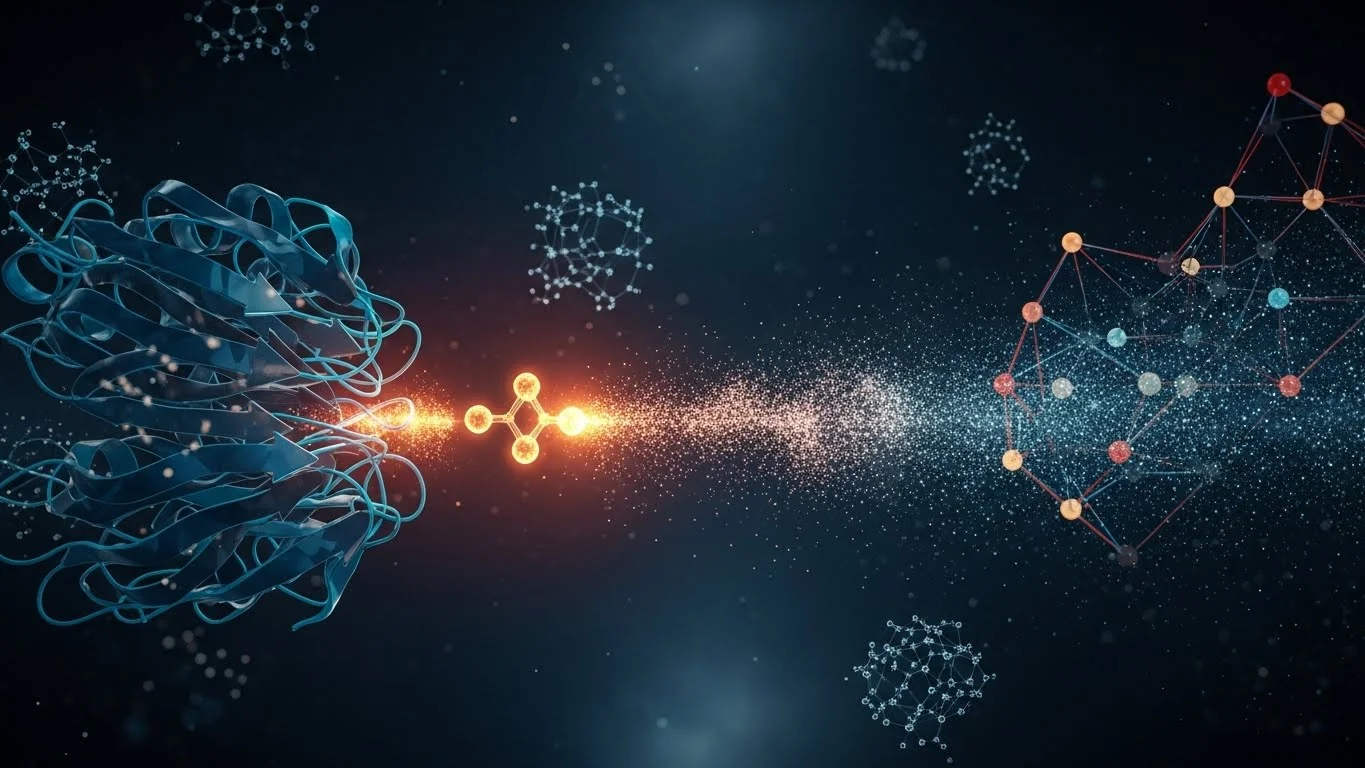
Table of Contents
- Introduction: The Post-AlphaFold Reality
- The Core Shift: Unified Tokenization and Diffusion
- Boltz-2 Under the Hood: The Affinity Head Innovation
- The Efficiency Frontier
- Architectural Divergence: Boltz-2 vs. The Field
- The Killer App: Generative Inverse Design
- Deployment: Running Boltz-2 at Scale
- Final Thoughts: The New Standard
Introduction: The Post-AlphaFold Reality
For the last three years, the field of structural biology has been living in the "Post-AlphaFold" reality. We solved the static folding problem for monomers, but for those of us in drug discovery, a perfectly folded protein is just the starting line. The real challenge—and the real value—lies in binding: predicting how that protein interacts with ligands, nucleic acids, and other proteins in a dynamic environment.
This year, the release of Boltz-2 by the MIT Jameel Clinic and Recursion has signaled a shift from structure prediction to interaction modeling. This is not just an incremental update; it is an architectural fork designed explicitly to bridge the "Affinity Gap" that has plagued deep learning models to date.
In this post, we take a technical deep dive into Boltz-2, comparing it with AlphaFold 3 (AF3) and Chai-1, and analyzing why "all-atom co-folding" is the new standard for lead identification.
The Core Shift: Unified Tokenization and Diffusion
To understand why the current generation of models outperforms classical docking, you have to look at the tokenization.
In the old stack (e.g., AlphaFold 2 + AutoDock Vina), the protein and the ligand were treated as separate entities. The protein was a sequence of residues; the ligand was a rigid graph. The "docking" was a post-hoc optimization problem, often trying to jam a flexible ligand into a rigid crystal structure.
Boltz-2 and AF3 change the primitive. They utilize a unified tokenization strategy where biological and chemical matter are processed in the same heterogeneous graph:
- Proteins: Tokenized at the residue level (with atom-level decoding)
- Ligands/DNA/RNA: Tokenized at the atomic level
This allows the model's attention mechanism to attend to a ligand atom with the same fidelity as a protein residue. The result is a true "induced fit" prediction: the protein side-chains and backbone adjust in real-time to the steric and electrostatic presence of the ligand during the generation process.
From Single-Pass to Diffusion
Instead of predicting rotation/translation matrices in a single pass (like AF2), these models use diffusion. They start with a noise distribution and iteratively denoise the coordinates of the entire complex simultaneously. This captures the joint probability distribution of the protein-ligand state, rather than just the lowest-energy state of the protein alone.
The diffusion paradigm enables several critical capabilities:
- Uncertainty quantification through multiple sampling passes
- Ensemble generation of plausible binding poses
- Joint optimization of protein conformation and ligand placement
Boltz-2 Under the Hood: The Affinity Head Innovation
While AF3 defined the architecture, Boltz-2 refined it for pharma. The most critical differentiation is its explicit focus on binding affinity.
AlphaFold 3 predicts structure. It does not natively tell you if a ligand is a nanomolar binder or a micromolar binder—it just gives you a confident pose. Boltz-2 introduces a Dual-Head Affinity Module that branches off the main PairFormer trunk:
| Head Type | Output | Optimized For |
|---|---|---|
| Binary Classification | Logistic score (0-1) predicting probability of binding | Hit Discovery (triage) |
| Continuous Regression | Prediction of pKd or pIC50 | Lead Optimization (ranking) |
This module was trained on approximately 750,000 high-quality protein-ligand pairs from ChEMBL and BindingDB. The architectural significance here is that the affinity prediction is conditioned on the generated structure. If the model hallucinates a bad pose, the affinity head (ideally) recognizes the poor contacts and penalizes the score.
The Structure-Affinity Coupling
The key insight is that Boltz-2 does not treat structure prediction and affinity prediction as separate problems. The affinity head receives embeddings from the same transformer trunk that generates the structure, creating a feedback loop where:
- Poor predicted contacts → Low affinity score
- Low affinity score → Signal to refine structure
- Refined structure → Better contact prediction
This coupling is what enables Boltz-2 to approach physics-based accuracy without the computational cost.
The Efficiency Frontier
The claim that has everyone talking is that Boltz-2 approaches Free Energy Perturbation (FEP) accuracy (R ≈ 0.66 vs R ≈ 0.7–0.8 for FEP) while being 1,000x faster.
| Method | Correlation (R) | Time per Complex | Use Case |
|---|---|---|---|
| Classical Docking | ~0.3–0.4 | Seconds | Initial screening |
| Boltz-2 | ~0.66 | ~20 seconds (H100) | High-throughput screening |
| FEP/MD | ~0.7–0.8 | Hours to days | Final validation |
While FEP remains the gold standard for final validation, Boltz-2 effectively democratizes "good enough" affinity prediction for high-throughput screening, running at approximately 20 seconds per complex on an H100 GPU.
The Economics of Screening
Consider a typical virtual screening campaign:
- Library size: 1 million compounds
- Classical docking: ~1 week on a cluster
- Boltz-2 screening: ~230 GPU-hours (achievable in hours with parallelization)
- FEP on 1M compounds: Computationally infeasible
Boltz-2 occupies a critical middle ground: fast enough for library-scale screening, accurate enough to dramatically reduce false positives before wet-lab validation.
Architectural Divergence: Boltz-2 vs. The Field
The landscape is becoming crowded. Here is how the top contenders stack up architecturally:
| Feature | Boltz-2 (Open Source) | AlphaFold 3 (DeepMind) | Chai-1 (Chai Discovery) |
|---|---|---|---|
| Backbone | 64-layer PairFormer | 48-block PairFormer | PairFormer + pLM Embeddings |
| Tokenization | Unified (Atoms + Residues) | Unified (Atoms + Residues) | Unified |
| Inference | Diffusion | Diffusion | Diffusion |
| Affinity | Explicit Dual-Head | Implicit (pLDDT/PAE) | Implicit |
| Specialty | Method Conditioning (NMR/MD) | Ions/Metals | Single-Sequence Mode |
| License | MIT (Open Weights/Code) | Closed / Restricted | Apache 2.0 (Open) |
Key Takeaways
AlphaFold 3 is still superior for metal ion coordination and complex PTMs due to its massive, diverse training set. When your target involves zinc fingers, iron-sulfur clusters, or heavily glycosylated proteins, AF3 remains the gold standard.
Chai-1 is the go-to for orphan proteins (single-sequence mode), where MSAs are not available. For novel protein families with few homologs in sequence databases, Chai-1's protein language model embeddings provide critical context.
Boltz-2 wins on integration. Its open license and affinity head make it the only viable "drop-in" replacement for a proprietary docking pipeline. You can deploy it on-prem, fine-tune it on your internal data, and build production workflows around it without licensing concerns.
The Killer App: Generative Inverse Design
The most exciting application of Boltz-2 is not just screening—it is generation.
Because the entire pipeline is differentiable, we can invert the process. BoltzGen is a wrapper around the architecture that allows for "hallucinating" binders. Instead of inputting a ligand and asking "does it bind?", you input a pocket and a target affinity, and the model diffuses a molecular structure (or peptide sequence) that fits the latent representation of a high-affinity binder.
This closes the loop between Virtual Screening and De Novo Design:
Traditional Pipeline:
[Library] → [Screen] → [Hits] → [Optimize] → [Lead]

Generative Pipeline:
[Target Pocket] + [Desired Properties] → [BoltzGen] → [Novel Binders]
Early Results
In early benchmarks, this approach generated nanomolar binders for 66% of novel targets tested—a hit rate that is orders of magnitude higher than random library screening, which typically yields hit rates of 0.01–0.1%.
The generative approach also enables:
- Scaffold hopping: Generating chemically distinct molecules with similar binding profiles
- Property optimization: Conditioning generation on ADMET properties simultaneously
- Novelty exploration: Pushing into unexplored chemical space beyond existing libraries
Deployment: Running Boltz-2 at Scale
For technical teams looking to deploy this, the "Open Source" tag is the critical enabler. Unlike AF3, which is gated behind a web server for commercial use, Boltz-2 can be containerized and run on-prem.
Infrastructure Options
NVIDIA BioNeMo: Boltz-2 is integrated as a NIM (NVIDIA Inference Microservice), optimized with cuEquivariance kernels to handle the massive compute of the 64-layer trunk.
Self-Hosted Deployment: The MIT license allows full deployment flexibility:
# Example deployment considerations
- Container: Docker/Singularity with CUDA 12.x
- Memory: 64GB+ GPU memory recommended
- Storage: Model weights ~15GB
- Networking: Consider batching for throughput
Hardware Requirements
Boltz-2 is hungry. You are looking at H100s or A100s to get that ~20s inference time. Attempting to run this on consumer hardware is theoretically possible but impractical for library-scale work.
| Hardware | Inference Time | Practical Use |
|---|---|---|
| H100 (80GB) | ~20 seconds | Production screening |
| A100 (80GB) | ~35 seconds | Production screening |
| A100 (40GB) | ~60 seconds | Development/testing |
| RTX 4090 | ~120+ seconds | Prototyping only |
Scaling Considerations
For library-scale screening (millions of compounds), consider:
- Batching: Group similar-sized ligands to maximize GPU utilization
- Precomputation: Cache protein embeddings for repeated screens against the same target
- Hierarchical filtering: Use faster methods (fingerprint similarity, 2D pharmacophore) for initial triage before Boltz-2
Final Thoughts: The New Standard
Boltz-2 is not a magic bullet. It still struggles with:
- Molecular glues: Ternary complex formation remains challenging
- Massive conformational changes: Induced fit beyond side-chain rearrangement
- Allosteric effects: Binding events far from the active site
- Covalent binders: Irreversible inhibitors require special handling
It is not a complete replacement for rigorous physics-based FEP when you need exact energy calculations (±1 kcal/mol).
The Strategic Value
However, as a filter, it is revolutionary. By moving the "Affinity Gap" upstream—filtering out non-binders with high-fidelity structure-based inference before they ever reach the FEP or wet-lab stage—it fundamentally changes the economics of the funnel.
Consider the traditional drug discovery funnel:
| Stage | Compounds | Cost per Compound | Total Cost |
|---|---|---|---|
| Virtual Screen | 1,000,000 | $0.01 | $10,000 |
| Docking Hits | 10,000 | $1 | $10,000 |
| Biochemical Assay | 1,000 | $100 | $100,000 |
| Cell-Based Assay | 100 | $1,000 | $100,000 |
If Boltz-2 can reduce the docking-to-biochemical false positive rate by 50%, the downstream savings are substantial—not just in dollars, but in time-to-candidate.
The Bottom Line
For the technical lead in 2025, the question is not "Should we use AI for folding?" It is "How fast can we integrate Boltz-2 into our screening loop?"
The shift from structure prediction to interaction modeling is not incremental—it is a paradigm change. The tools that bridge the affinity gap will define the next generation of computational drug discovery platforms. Boltz-2, with its open license, explicit affinity prediction, and generative capabilities, is currently the most accessible entry point into this new era.
The "Interaction Era" has begun.
Note: This analysis reflects the state of these tools as of late 2025. The field is evolving rapidly, and capabilities continue to improve with each model release.
#drugDiscovery #computationalBiology #AI #machineLearning #proteinStructure #Boltz2 #AlphaFold

About Ryan Wentzel
Ryan previously served as a PCI Professional Forensic Investigator (PFI) of record for 3 of the top 10 largest data breaches in history. With over two decades of experience in cybersecurity, digital forensics, and executive leadership, he has served Fortune 500 companies and government agencies worldwide.
Related Articles
Taming the LLM: Using Finite-State Machines to Prevent Hallucinations in AI Workflows
Hallucinations are not a prompt problem—they are an architecture problem. Here is how wrapping LLM calls in a Finite-State Machine transforms a probabilistic model into a predictable, inspectable software component you can ship to paying customers.
6 Min. ReadRead more →

Embracing the Cycle: A Pragmatic Look at TDD in Ruby on Rails
How Red–Green–Refactor keeps SaaS codebases shippable as they scale — and why pragmatic TDD pays compounding dividends for Rails teams.
5 Min. ReadRead more →
The Algorithmic Trust Paradox: How iOS 26 and FinanceKit Are Rewiring Fintech After the AI Hallucination Crisis
How Apple Intelligence hallucinations exposed fragile market microstructure, and why iOS 26's Liquid Glass UI and FinanceKit API are fundamentally reshaping fintech data provenance, algorithmic trading, and the death of screen scraping.
6 Min. ReadRead more →