Loading…
Beyond the Smart Thermostat: The 'Digital Twin' Revolution in Commercial Real Estate
By Ryan Wentzel
5 Min. Read#real-estate#PropTech#commercial-real-estate#IoT#smart-buildings
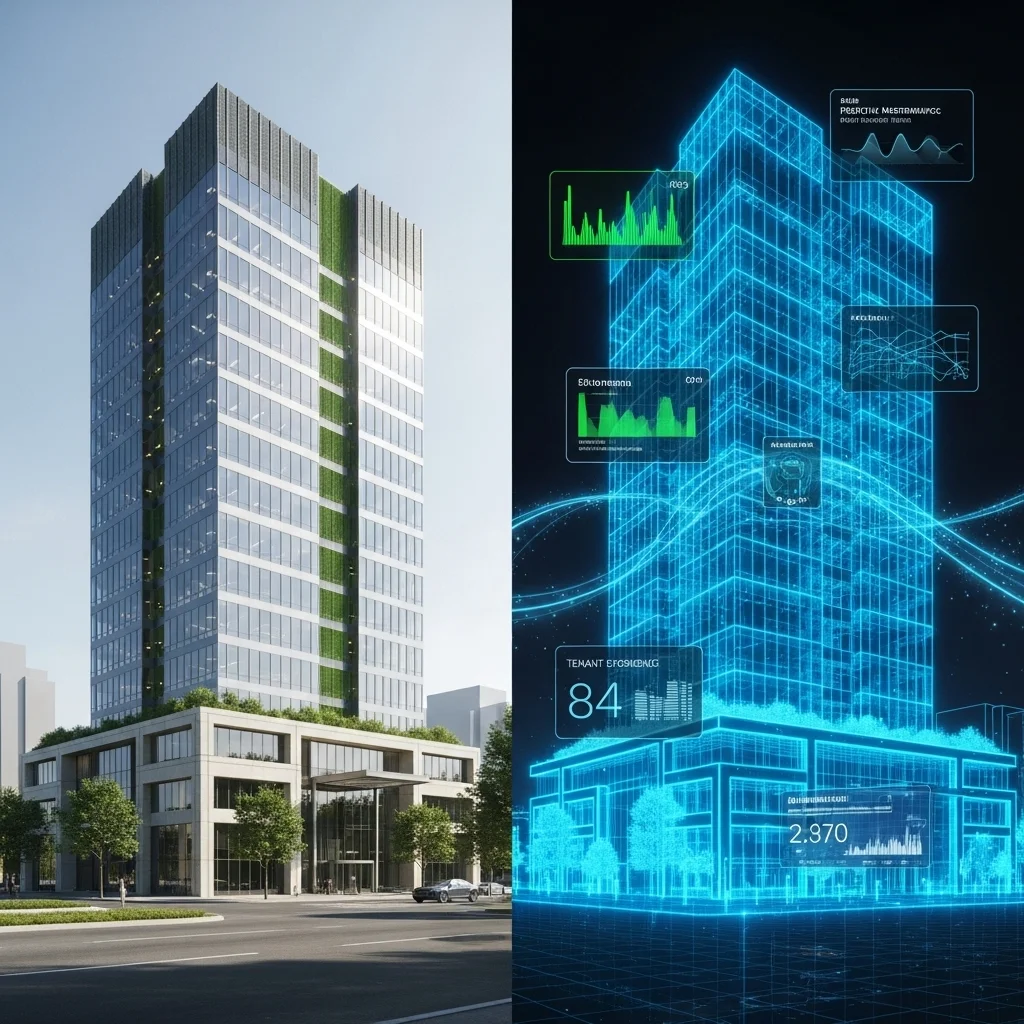
Table of Contents
- I. Your Building Is "Connected," Not "Smart"
- II. The 'Digital Twin': A Living Model, Not a Static Blueprint
- III. The ROI for Asset Managers: From Predictive Maintenance to Energy Optimization
- IV. The Technology Stack: How IoT Sensors "Feed" the Twin
- V. The Future of Asset Management: Simulating Your Building's Future
I. Your Building Is "Connected," Not "Smart"
A provocation for commercial asset managers: most buildings labeled "smart" are merely connected. A smart thermostat, a key-fob access system, or an automated lighting grid is a "smart device." It is a siloed, single-purpose tool. It does not make the building a "smart asset." The building itself remains a static, "dumb" collection of disparate systems that do not talk to each other.
The true revolution in commercial real estate (CRE) is the "Digital Twin." This technology moves far beyond simple connected devices to create a living, breathing, virtual model of the physical asset. This living model allows owners and asset managers to optimize operations, predict failures, and maximize net operating income (NOI) on a scale that was previously impossible.
II. The 'Digital Twin': A Living Model, Not a Static Blueprint
It is critical to understand what a digital twin is not. It is often confused with a BIM (Building Information Model), but the two are fundamentally different.
A BIM is... a static, 3D blueprint. It is an incredibly rich and valuable design and construction document, a perfect "snapshot" of the building's as-built state. But it is static. It does not change after construction is complete.
A Digital Twin is... a living model. It is a dynamic platform that starts with the BIM, but then "supercharges" it by fusing it with a continuous, real-time data feed from thousands of sensors. It is a "smart mirror" of the building's current operational state.
The true power of a digital twin is not just monitoring the present; it's the ability to simulate the future. This is the single biggest differentiator from a "smart building." A "smart building" dashboard monitors data: "The HVAC on Floor 5 is on". A "Digital Twin" knows the HVAC on Floor 5 is on, but it also knows its make, model, full maintenance history, its real-time energy draw, and the real-time occupancy of Floor 5 from IoT sensors.
Because it has this rich, integrated model, the asset manager can now simulate scenarios: "What is the simulated impact on energy cost, tenant comfort, and asset lifespan if we raise the temperature setpoint by 2 degrees?". This ability to test and validate changes in a virtual, risk-free environment before deploying them physically is the game-changer.
III. The ROI for Asset Managers: From Predictive Maintenance to Energy Optimization
For CRE asset managers, this technology is not a gimmick. It is a core driver of Net Operating Income (NOI) and asset value, solving three of the biggest operational challenges.
Predictive Maintenance & CapEx Optimization
The traditional "break-fix" maintenance model is costly and reactive. The "scheduled" model (e.g., replacing a $100k chiller every 15 years) is inefficient. A digital twin uses IoT vibration and performance sensors to continuously monitor critical equipment. It measures Key Performance Indicators like Mean Time Between Failure (MTBF) and Mean Time To Repair (MTTR) for every asset. This allows operators to perform predictive maintenance—fixing a component before it breaks—and enables asset managers to base capital investment decisions on the true operating cost and lifetime value of equipment, not just a generic schedule.
Radical Energy Optimization
Buildings are responsible for approximately 40% of all energy consumption. A digital twin attacks this inefficiency. It integrates real-time occupancy data (from IoT sensors), external weather forecasts, and dynamic utility-grid pricing. It then automatically and dynamically adjusts HVAC and lighting on a zone-by-zone basis to match demand perfectly. Case studies and implementations (e.g., in Singapore's Smart City initiative and by Microsoft) show this can drive energy savings of 15% to 30% or more.
Operational Cost Savings
The twin provides a portfolio-level view, allowing for more efficient, centralized allocation of engineering staff rather than costly on-site teams. It enables remote troubleshooting, and dramatically lowers the cost of onboarding new staff. A new building operator can learn the building's systems and critical equipment locations virtually in the digital twin before ever stepping foot on-site.
IV. The Technology Stack: How IoT Sensors "Feed" the Twin
This entire system is made possible by the "Internet of Things" (IoT). The digital twin is the "brain," and the thousands of IoT sensors are its "central nervous system." These sensors are the embedded technologies that "feed" the twin the dynamic, real-time data it needs to come to life.
This goes far beyond a simple smart thermostat. These sensors collect data on:
Building Systems
HVAC, lighting, energy, access control, water, and elevators.
Environmental Data
Occupancy (e.g., non-intrusive movement monitors), temperature, light, humidity, indoor air quality (CO2), sound, and even vibration on critical machinery.
This continuous, high-velocity data stream is layered onto the static 3D model, creating a "real-time picture of what is happening in the building at that precise moment," which can then be fed into machine learning models to be analyzed.
V. The Future of Asset Management: Simulating Your Building's Future
The market for this technology is exploding, projected to grow from $8 billion in 2022 to over $90 billion by 2032. The reason is the clear, hard-dollar ROI.
The future of asset management is not just in optimizing one building, but in portfolio-level benchmarking. A digital twin platform allows an asset manager to finally get data-driven answers to their most valuable questions: "Which of my buildings is operating most efficiently? Why? And how can I deploy those 'best-in-class' strategies from Building A to the rest of my portfolio?".
The Digital Twin revolution is finally turning the abstract concept of a "smart building" into a hard-dollar reality. It transforms a static CRE asset into a dynamic, hyper-efficient, and data-driven system. For asset managers, this is not just about cutting costs; it is about proving higher NOI, lower risk, and ultimately, creating a more valuable and resilient asset.
#realEstate #PropTech #commercialRealEstate #IoT #smartBuildings #assetManagement #sustainability #digitalTwins

About Ryan Wentzel
Ryan previously served as a PCI Professional Forensic Investigator (PFI) of record for 3 of the top 10 largest data breaches in history. With over two decades of experience in cybersecurity, digital forensics, and executive leadership, he has served Fortune 500 companies and government agencies worldwide.
Related Articles
The Babel of the Soil: The Engineering Challenge of Mixed-Fleet Autonomy
A technical dissection of the interoperability crisis preventing true mixed-fleet autonomy in agriculture—from the 250 kbit/s limits of ISOBUS to semantic fragmentation in cloud APIs and the security paradox of retrofit solutions.
8 Min. ReadRead more →
The Living Mirror: How Digital Twins Are Hacking the Soil Microbiome
A technical deep dive into Soil Digital Twins—the convergence of edge computing, GAN-based microbiome simulation, and real-time sensor fusion that is shifting agriculture from reactive precision to predictive regeneration.
8 Min. ReadRead more →
The New 'Shovel-Sellers' of the AI Gold Rush: Why Data Centers Are the Hottest Asset in Real Estate
While everyone chases AI software gold, the real fortunes are being made in the physical infrastructure—data centers have become the most strategic asset class in commercial real estate.
5 Min. ReadRead more →