Loading…
The $100 Billion Compliance Problem: How 'RegTech' and 'Explainable AI' Are Saving Banks from Themselves
By Ryan Wentzel
5 Min. Read#finance#RegTech#explainable-AI#compliance#AML
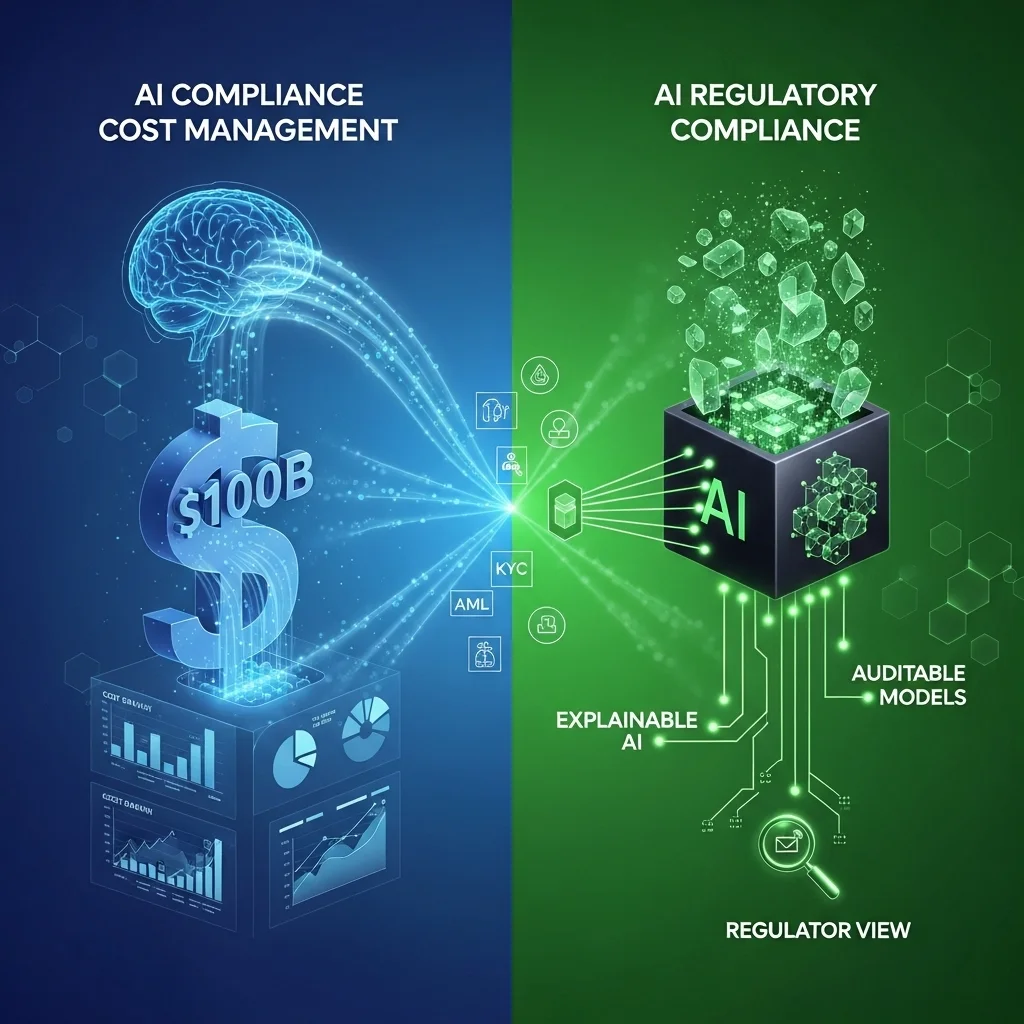
Table of Contents
- I. The Two-Front War of Financial AI
- II. The $100 Billion Problem: Automating the Crushing Cost of Compliance
- III. The 'Black Box' Conundrum: When Your AI Becomes a Regulatory Liability
- IV. The Solution: How Explainable AI (XAI) Makes Models Auditable-by-Design
- V. The Strategic Imperative: From Opaque Risk to Provable Trust
I. The Two-Front War of Financial AI
Financial institutions are caught in a strategic paradox—a two-front war defined entirely by AI. On the first front, firms are aggressively adopting AI as an offensive weapon. They are deploying Regulatory Technology (RegTech) to automate and manage the crushing, multi-hundred-billion-dollar cost of global compliance. On the second front, they are playing defense against a new wave of regulation. Global bodies, from the EU to the US, are passing stringent laws against the use of opaque, "black box" AI, especially in high-stakes areas like credit and lending.
This creates a central conflict: a bank's AI-powered compliance tool could, itself, be non-compliant. The only way to win this war is to deploy AI that can police itself. This is the critical convergence point where RegTech and Explainable AI (XAI) meet, enabling institutions to use AI to manage compliance while remaining compliant themselves.
II. The $100 Billion Problem: Automating the Crushing Cost of Compliance
Traditional compliance is a manual, costly, and error-prone nightmare. The "solution" for the past two decades has been to hire more people, leading to bloated, inefficient, and slow compliance departments. RegTech, or Regulatory Technology, is the application of modern technology—primarily AI, machine learning, and data analytics—to streamline and automate these processes.
The primary applications of AI-driven RegTech include:
Automated AML/KYC
AI streamlines the entire client onboarding process. It automates data collection, document verification, and—critically—the screening of customers against global sanctions lists, watchlists, and lists of Politically Exposed Persons (PEPs).
Intelligent, Risk-Based KYC
This is a crucial evolution. Traditional KYC is a static, one-time check at onboarding. AI-powered RegTech enables dynamic, risk-based KYC. It uses real-time data and behavioral analytics to continuously monitor customer profiles. If a customer's behavior changes, the AI can dynamically adjust their risk score and trigger a due diligence review, catching risks that emerge after onboarding.
AI-Powered Transaction Monitoring
Instead of using static, high-false-positive rules to find suspicious activity, AI analyzes vast transaction datasets to identify true anomalies. This significantly improves detection accuracy and reduces the costly operational drag of investigating false positives.
By automating these labor-intensive tasks, RegTech transforms compliance from a static cost center into a dynamic, efficient, and proactive risk management function.
III. The 'Black Box' Conundrum: When Your AI Becomes a Regulatory Liability
Herein lies the paradox. The most powerful AI models, such as neural networks and deep learning, are often "black boxes". Their internal workings are opaque, and their decision-making logic is inscrutable, even to the data scientists who built them. The model provides an answer (e.g., "Deny loan," "Flag for AML") but cannot articulate why.
In the highly regulated financial sector, an unexplainable model is not a competitive advantage; it is a regulatory liability.
The Regulatory Squeeze
New laws explicitly forbid this opacity. The EU AI Act, for example, designates financial services like credit scoring as "high-risk" systems and imposes explicit transparency and explainability obligations.
The Legal Mandate
In the US, Fair Lending laws like the Equal Credit Opportunity Act (ECOA) legally require financial institutions to provide "adverse action" notices that give specific, principal reasons for a credit denial. "The algorithm said no" is not a legally compliant reason.
The "Weapon of Math Destruction" Risk
The greatest fear for any executive team is that their model, trained on biased historical data, has become a "Weapon of Math Destruction". "Historical bias" (data reflecting past societal prejudices) or "representation bias" (unbalanced datasets) can create an AI that systematically and illegally discriminates, even if the intent was fair.
The result is a bank that can build a hyper-accurate, highly profitable lending model that it cannot legally deploy because it cannot be audited.
IV. The Solution: How Explainable AI (XAI) Makes Models Auditable-by-Design
Explainable AI (XAI) is the set of tools and techniques designed to "open the black box" and solve this conundrum. XAI provides a technical bridge, allowing firms to use high-performance, complex AI models while meeting their non-negotiable regulatory and ethical obligations.
Here is how XAI makes models auditable by design:
It Provides Auditability
XAI translates a model's complex behavior into human-inspectable reasons. This enables effective internal audits, validation by model risk management teams, and—most importantly—provides the "proof of compliance" that regulators demand.
It Enables Proactive Bias Detection
Instead of just testing a model's outcomes (a reactive check), XAI allows developers and auditors to probe the model's internal logic (a proactive assessment). This helps detect and mitigate bias before the model ever impacts a customer.
It Deploys Specific Techniques
The most common XAI methods are post-hoc, model-agnostic techniques like LIME (Local Interpretable Model-Agnostic Explanations) and SHAP (SHapley Additive exPlanations).
A practical case study in AI-driven lending demonstrates this power. When a complex AI model denies a loan, XAI is used in two ways:
For the Customer: The XAI system (using SHAP) automatically identifies the key factors that led to the denial (e.g., "High revolving utilization," "Insufficient credit history"). This output is used to auto-generate the legally-compliant adverse action notice.
For the Regulator: During a fair lending audit, the bank can use XAI outputs to prove that protected-class attributes (like race, gender, or zip code) were not the drivers of its credit decisions, demonstrating fairness and mitigating bias.
This approach also solves a critical governance problem. The risk of black-box AI is "automation bias," the tendency for human operators to blindly trust the model's output. XAI prevents this by giving the human-in-the-loop the evidence needed to challenge or validate the AI's decision. Furthermore, risk teams can use XAI to monitor "feature contributions" over time. If a model suddenly starts "drifting" and weighing a spurious factor heavily, XAI is the system that flags it. This makes XAI not just a compliance tool, but a core C-suite tool for ensuring AI models remain effective, fair, and aligned with business goals.
V. The Strategic Imperative: From Opaque Risk to Provable Trust
The "window for painless XAI is closing". Institutions that wait to "bolt on" explainability to their existing black-box models will face massive technical debt and regulatory risk. XAI must be "baked in" from the start as a non-negotiable governance requirement.
This requires the formal adoption of governance frameworks like the NIST AI Risk Management Framework 1.0 and ISO standards (e.g., ISO 42001) to build a management discipline for trustworthy AI.
XAI is the essential bridge. It is the only technology that allows financial institutions to resolve their two-front war. It transforms AI from an opaque, high-risk, and potentially non-compliant liability into a transparent, auditable, and trustworthy strategic asset that regulators can approve and executives can trust.
#finance #RegTech #explainableAI #compliance #AML #KYC #AIgovernance #fintech #financialRegulation

About Ryan Wentzel
Ryan previously served as a PCI Professional Forensic Investigator (PFI) of record for 3 of the top 10 largest data breaches in history. With over two decades of experience in cybersecurity, digital forensics, and executive leadership, he has served Fortune 500 companies and government agencies worldwide.
Related Articles

The 2026 Survival Guide: How Regulatory Convergence and Supply Chain Attacks Rewrote the Security Playbook
With DORA, NIS2, and SEC disclosure rules in full enforcement, compliance is no longer a check-the-box exercise—it's an engineering constraint. Here's how to navigate supply chain security and regulatory convergence in 2026.
8 Min. ReadRead more →

The Architecture of Trust: Operationalizing Frontier AI in Regulated Industries
How financial services and life sciences organizations can deploy frontier AI models safely through secure data pipelines, rigorous governance structures, and the strategic leadership of a Fractional CAIO—bridging the gap between 'move fast' and 'verify everything'.
15 Min. ReadRead more →

Engineering the EU AI Act: A Technical Blueprint for 'Compliance-by-Design'
From 'Black Box' to 'Glass Box': translating the EU AI Act's dense legal requirements into concrete architectural patterns using AI Gateways, immutable audit logs, and Human-in-the-Loop state machines.
6 Min. ReadRead more →