Loading…
The 2026 Survival Guide: How Regulatory Convergence and Supply Chain Attacks Rewrote the Security Playbook
By Ryan Wentzel
8 Min. Read#AI & Technology#security#compliance#supply chain#DORA
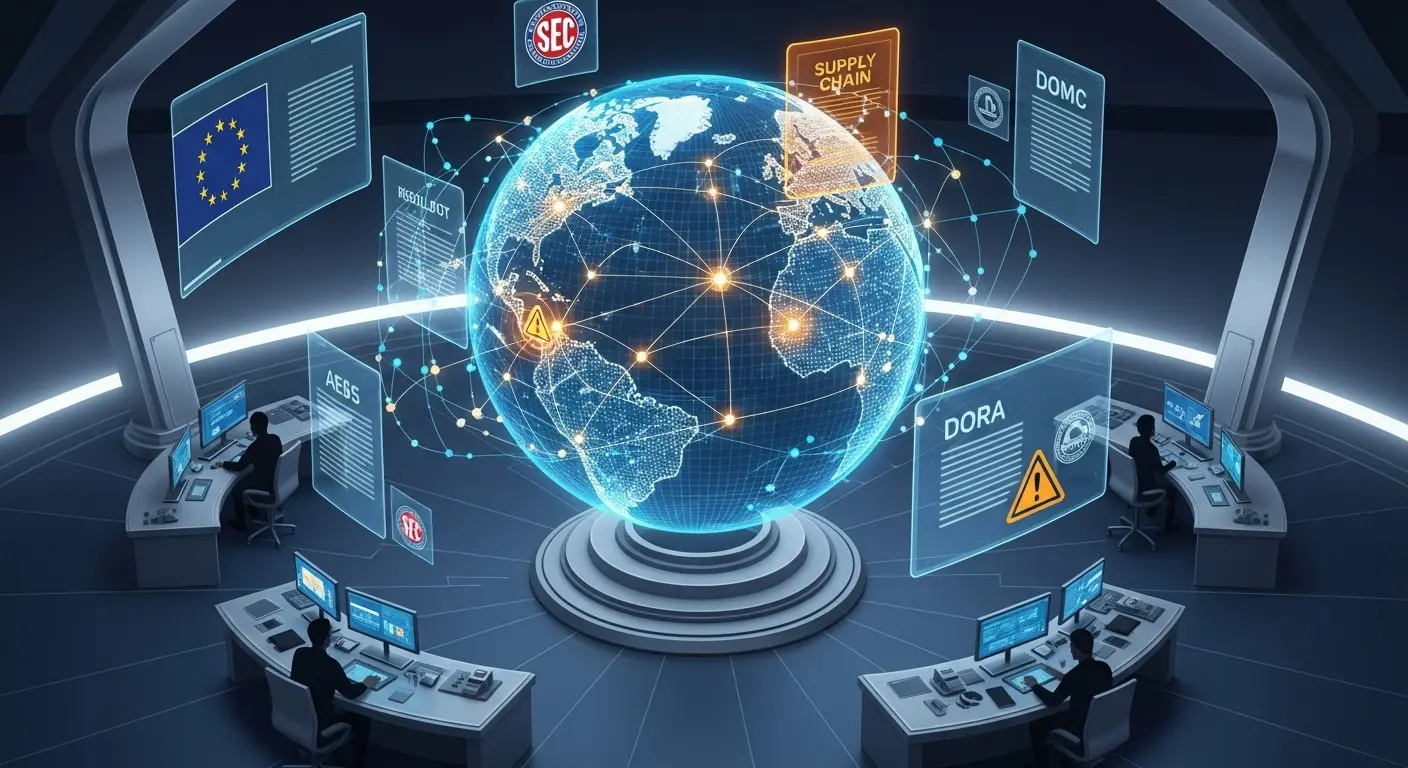
Table of Contents
- Introduction: The End of the Hardened Perimeter
- The "Side Door" Post-Mortem: Technical Lessons from 2025
- Solving "Dependency Hell" with VEX
- Compliance as Code: The OSCAL Revolution
- The Engineer's Checklist for 2026
- The Regulatory Convergence Matrix
- Conclusion: Compliance as Architecture
Introduction: The End of the Hardened Perimeter
If 2025 taught us anything, it's that the "hardened perimeter" is a relic.
Last year, we watched sophisticated threat actors bypass firewalls and EDRs by simply walking through the "side doors"—our vendors, our dependencies, and our trusted integrations. Now, in early 2026, the regulatory bill has come due.
With the full enforcement of DORA (Digital Operational Resilience Act), the new NIS2 amendments, and the SEC's rigorous disclosure rules, compliance is no longer a "check-the-box" exercise for legal teams; it is an engineering constraint.
For technical leaders, architects, and security engineers, here is what the new landscape of supply chain security and regulatory convergence looks like in practice.
The "Side Door" Post-Mortem: Technical Lessons from 2025
To understand the regulatory shift, we have to look at the architectural failures that drove it. 2025's biggest breaches didn't rely on zero-days in the kernel; they relied on trust relationships.
The "Non-Technical" Dev Environment Hack (ByBit)
The $1.5 billion heist at ByBit wasn't a direct attack on their exchange. Attackers social-engineered a developer at a third-party wallet provider (Safe{Wallet}), compromising a workstation that lacked internal MFA. From there, they pivoted to AWS, injecting malicious code into the build pipeline.
The Attack Chain:
Social Engineering → Developer Workstation → AWS Access → Build Pipeline → Production Code
        ↓                    ↓                   ↓              ↓              ↓
   Phishing Email      No Internal MFA      Lateral Move   Code Injection   $1.5B Loss
The Lesson: Code integrity is moot if your pipeline is compromised. Phishing-resistant MFA (FIDO2) is now mandatory for anyone with commit access to production or CI/CD environments.
The OAuth Abuse (Salesforce/Gainsight)
Attackers bypassed authentication entirely by stealing OAuth tokens from third-party integrations (Gainsight and Salesloft). Because these were "trusted" apps with broad scopes, the exfiltration of data looked like legitimate API traffic.
| Attack Vector | Why It Worked | Detection Difficulty |
|---|---|---|
| OAuth token theft | Tokens had excessive scopes | Appeared as legitimate traffic |
| Third-party trust | Apps were "approved" integrations | No anomaly in auth logs |
| API exfiltration | Read access was expected behavior | Volume was within normal bounds |
The Lesson: Non-Human Identities (NHIs) are the new privileged users. You must audit OAuth scopes and implement "least privilege" for API tokens, not just humans.
The Logistics Paralysis (Ingram Micro)
A compromised VPN gateway allowed the SafePay ransomware group to paralyze global IT distribution.
The Lesson: Resilience > Prevention. DORA now explicitly mandates "exit strategies" for critical providers. You must prove you can survive if your primary vendor goes dark.
Summary: The Trust Relationship Attack Surface
| Incident | Attack Vector | Regulatory Response |
|---|---|---|
| ByBit | Third-party developer compromise | DORA ICT risk management |
| Salesforce/Gainsight | OAuth token abuse | NIS2 supply chain requirements |
| Ingram Micro | VPN gateway compromise | SEC 4-day disclosure mandate |
Solving "Dependency Hell" with VEX
We are all shipping "Dependency Hell."
A typical microservice pulls in hundreds of libraries. With the EU Cyber Resilience Act (CRA) and US Executive Order 14028 making SBOMs (Software Bill of Materials) mandatory, engineering teams are drowning in noise. A raw SBOM scan might flag 2,000 "Critical" CVEs, 90% of which are never loaded into memory.
The solution for 2026 is VEX (Vulnerability Exploitability eXchange).
What Is VEX?
VEX is a machine-readable artifact (JSON) that sits alongside your SBOM. It allows you (or your vendor) to assert the status of a vulnerability in the context of the product.
{
  "vulnerability": "CVE-2025-12345",
  "product": "my-service:v2.1.0",
  "status": "not_affected",
  "justification": "vulnerable_code_not_in_execute_path",
  "statement": "The vulnerable function in lib-crypto is not called in our implementation"
}
The Power of "Not Affected"
Instead of patching a library that isn't actually used, you can issue a VEX statement with a status of not_affected and a justification like vulnerable_code_not_in_execute_path.
Without VEX:
- Security blocks the release because of a Critical CVE in
lib-crypto - Engineering spends 3 days proving the function isn't called
- Release delayed, velocity destroyed
- Same conversation repeats next sprint
With VEX:
- The scanner ingests the VEX file
- Sees the
not_affectedstatus with valid justification - Passes the build automatically
- Audit trail preserved for compliance
VEX Status Types
| Status | Meaning | Use Case |
|---|---|---|
not_affected |
Vulnerability doesn't apply | Function not called, config not used |
affected |
Vulnerability applies, action needed | Prioritize remediation |
fixed |
Vulnerability was present, now patched | Historical record |
under_investigation |
Still analyzing | Buys time while assessing |
Tooling for VEX Workflows
Tools like CycloneDX, Syft, and Dependency-Track have matured to support this workflow, allowing you to automate the suppression of false positives legally and securely.
| Tool | VEX Capability | Integration |
|---|---|---|
| CycloneDX | Native VEX generation | CI/CD pipelines |
| Syft | SBOM + VEX correlation | Container scanning |
| Dependency-Track | VEX consumption + policy | Continuous monitoring |
| Grype | VEX-aware scanning | Developer workstations |
Compliance as Code: The OSCAL Revolution
The days of taking screenshots for an annual audit are over.
DORA and the SEC require continuous evidence of your security posture. If you drift out of compliance on Tuesday, you can't wait until the next audit to fix it.
The industry is standardizing on OSCAL (Open Security Controls Assessment Language). This NIST-backed standard transforms compliance controls (like "Ensure MFA is enabled") into machine-readable code (XML/JSON).
How OSCAL Works in Production
1. Policy Layer
You define your requirement (e.g., NIS2 Article 21) in an OSCAL Profile:
{
  "profile": {
    "id": "nis2-article-21",
    "imports": [
      {
        "href": "nist-800-53-catalog.json",
        "include-controls": [{ "with-id": "AC-2" }, { "with-id": "IA-2" }]
      }
    ]
  }
}
2. Implementation Layer
Your CSPM (Cloud Security Posture Management) tool (e.g., Wiz, Prisma Cloud) queries your AWS/Azure APIs continuously.
3. Verification Layer
If a junior dev disables MFA on an S3 bucket, the tool detects the drift against the OSCAL profile immediately and triggers an alert.
From Snapshot to Cinema
| Model | Frequency | Detection Latency | Regulatory Fit |
|---|---|---|---|
| Snapshot | Annual audit | Up to 364 days | Pre-2025 |
| Periodic | Quarterly scans | Up to 89 days | Transitional |
| Cinema | Continuous stream | Minutes to hours | DORA/NIS2/SEC |
This moves compliance from a "Snapshot" model (once a year) to a "Cinema" model (continuous stream), which is the only way to satisfy:
- The 4-day incident reporting window required by the SEC
- The rigorous oversight requirements of NIS2
- The continuous ICT risk monitoring mandated by DORA
Compliance Automation Platforms
For organizations not ready to build custom OSCAL pipelines, platforms have emerged to bridge the gap:
| Platform | Strength | Best For |
|---|---|---|
| Drata | Continuous monitoring + evidence | SOC 2, ISO 27001 |
| Vanta | Broad framework coverage | Multi-framework compliance |
| Secureframe | Developer-friendly integration | Startups scaling compliance |
| Anecdotes | Enterprise GRC + OSCAL native | Large regulated enterprises |
The Engineer's Checklist for 2026
To navigate this landscape, prioritize these three technical initiatives:
1. Automate VEX Ingestion
Don't just generate SBOMs; build pipelines that consume VEX data to filter out noise.
Implementation Steps:
- Integrate VEX-aware scanners into CI/CD (Grype, Trivy)
- Establish VEX generation process for first-party code
- Demand VEX files from vendors—it's likely a requirement in your new contracts under NIS2
- Create policy gates that differentiate
affectedfromnot_affected
2. Audit Non-Human Identities
Deploy tools to discover and restrict over-privileged OAuth tokens and service accounts. Treat an API key with the same suspicion as a Domain Admin password.
Implementation Steps:
- Inventory all OAuth integrations and their scopes
- Implement just-in-time access for service accounts
- Deploy NHI discovery tools (Astrix, Oasis Security)
- Establish rotation policies for all API credentials
- Monitor for anomalous API usage patterns
3. Adopt "Compliance as Code"
Map your technical controls to OSCAL or use a compliance automation platform that supports continuous monitoring. You need to prove resilience via APIs, not PDFs.
Implementation Steps:
- Select OSCAL tooling or compliance platform
- Map existing controls to machine-readable format
- Integrate with CSPM for continuous posture assessment
- Build dashboards for real-time compliance visibility
- Establish alerting for drift detection
The Regulatory Convergence Matrix
Understanding how regulations overlap is critical for efficient compliance:
| Requirement | DORA | NIS2 | SEC | CRA |
|---|---|---|---|---|
| SBOM mandatory | ○ | ● | ○ | ● |
| Incident reporting | ● | ● | ● | ● |
| Supply chain due diligence | ● | ● | ○ | ● |
| Continuous monitoring | ● | ● | ● | ○ |
| Exit strategies | ● | ○ | ○ | ○ |
| Board-level accountability | ● | ● | ● | ○ |
● = Explicit requirement | ○ = Implied or partial
Conclusion: Compliance as Architecture
The regulatory convergence of 2026 isn't just about avoiding fines; it's a blueprint for building systems that can survive in a hostile supply chain.
The organizations that thrive will be those that recognized a fundamental truth: compliance is not a legal function—it's an engineering discipline.
The "side doors" that attackers exploited in 2025—the third-party developers, the OAuth tokens, the trusted integrations—were architectural decisions. The regulations of 2026 are forcing us to treat them as such.
The Bottom Line
- Your vendors are your attack surface. DORA mandates you manage them accordingly.
- Your dependencies are your liability. VEX transforms SBOM noise into actionable intelligence.
- Your compliance posture is your competitive advantage. Continuous monitoring is the new table stakes.
The hardened perimeter is dead. Long live the resilient supply chain.
Build accordingly.

About Ryan Wentzel
Ryan previously served as a PCI Professional Forensic Investigator (PFI) of record for 3 of the top 10 largest data breaches in history. With over two decades of experience in cybersecurity, digital forensics, and executive leadership, he has served Fortune 500 companies and government agencies worldwide.
Related Articles

Taming the LLM: Using Finite-State Machines to Prevent Hallucinations in AI Workflows
Hallucinations are not a prompt problem—they are an architecture problem. Here is how wrapping LLM calls in a Finite-State Machine transforms a probabilistic model into a predictable, inspectable software component you can ship to paying customers.
6 Min. ReadRead more →
The Algorithmic Trust Paradox: How iOS 26 and FinanceKit Are Rewiring Fintech After the AI Hallucination Crisis
How Apple Intelligence hallucinations exposed fragile market microstructure, and why iOS 26's Liquid Glass UI and FinanceKit API are fundamentally reshaping fintech data provenance, algorithmic trading, and the death of screen scraping.
6 Min. ReadRead more →
The Security Risks Hiding Behind Notion's Sleek Interface: Why Enterprise IT Leaders Should Think Twice
A deep technical analysis of Notion's architectural security gaps, permission model failures, AI exfiltration vulnerabilities, and why enterprise IT leaders should look past the polished UI before adopting it as a system of record.
14 Min. ReadRead more →