Loading…
Not Just Breaking Codes: How Quantum Computing Will Revolutionize Financial Modeling
By Ryan Wentzel
5 Min. Read#Quantum#finance#fintech
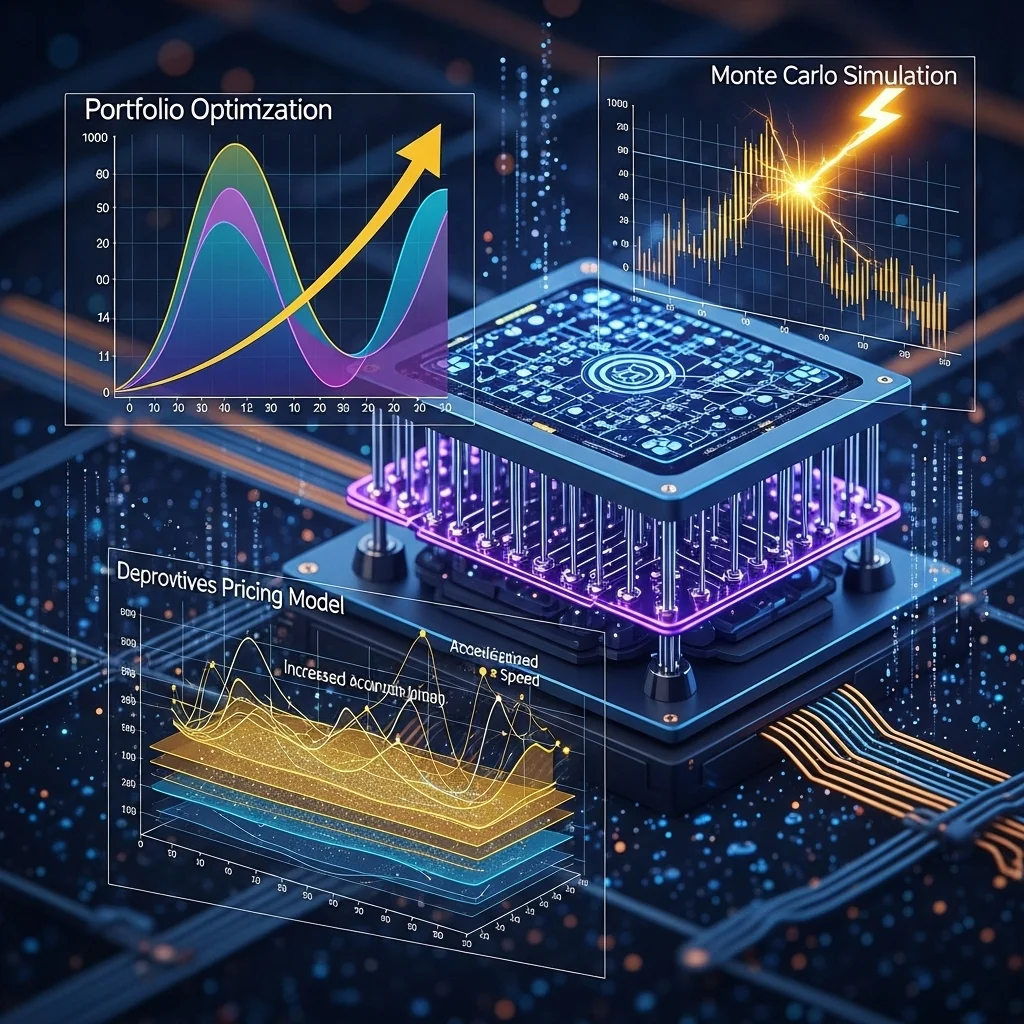
Table of Contents
- I. The Quantum Conversation Is Wrong
- II. The Optimization Opportunity: A Problem Classically Intractable
- III. The "Quadratic Speedup": Quantum-Charged Monte Carlo Simulations
- IV. The New Toolkit: QAOA, VQE, and Real-World Applications
- V. The Strategic Tipping Point: From "If" to "When"
I. The Quantum Conversation Is Wrong
The C-suite conversation about quantum computing in finance is disproportionately focused on a single topic: risk. The narrative is one of "crypto-apocalypse"—the day a fault-tolerant quantum computer running Shor's algorithm will render all classical encryption (like RSA) obsolete. This is a real, strategic threat. It has triggered a "harvest now, decrypt later" arms race, where adversaries are stockpiling encrypted data today, confident they can break it tomorrow. This, in turn, has fueled a necessary focus on defensive technologies like Post-Quantum Cryptography (PQC) and Quantum Key Distribution (QKD).
But this myopic, defense-only posture is causing executives to miss the multi-trillion-dollar offensive opportunity. The real quantum revolution in finance isn't about breaking codes; it's about running models that are computationally impossible for any classical computer. The true value lies not in cryptography, but in optimization.
II. The Optimization Opportunity: A Problem Classically Intractable
The most valuable and complex challenges in finance—such as portfolio optimization, derivatives pricing, and complex risk modeling—are combinatorial optimization problems. A classical computer, even a supercomputer, struggles to find the globally optimal portfolio from thousands of assets with hundreds of complex, real-world constraints (e.g., transaction costs, tax implications, sector limits). The "search space" is exponentially large. As a result, classical solvers get stuck in "locally optimal" solutions—a "good-enough" approximation that is computationally feasible.
Quantum computers are, by their very nature, designed to handle this high-dimensional, combinatorial complexity. By leveraging quantum phenomena like superposition and entanglement, they can explore all possibilities simultaneously to find the single, globally optimal solution.
This represents a fundamental strategic shift: from approximation to precision. Modern finance, as defined by Modern Portfolio Theory (MPT), is built on simplified models that make broad assumptions to reduce complexity to a point that classical computers can handle. We knowingly strip out real-world complexity to make the math feasible. Quantum computing allows us to remove those simplifying assumptions. It enables the modeling of the full, complex, non-linear reality of the market. This is the difference between "a good guess" based on a simplified model and "the precise answer" based on the complete problem. In a market where a single basis point can be worth millions, this is the definition of alpha.
III. The "Quadratic Speedup": Quantum-Charged Monte Carlo Simulations
The single most potent, non-hypothetical application of quantum advantage in finance is the acceleration of Monte Carlo simulations. These simulations are the workhorse of quantitative finance, used for everything from pricing complex financial derivatives to calculating systemic risk metrics like Value-at-Risk (VaR) and Conditional Value-at-Risk (CVaR).
The advantage is mathematically precise and is known as the "quadratic speedup".
Classical Monte Carlo: To achieve a pricing accuracy of $\epsilon$ (epsilon), a classical computer must run $O(1/\epsilon^{2})$ steps.
Quantum Monte Carlo: A quantum algorithm, using a subroutine called Amplitude Estimation, achieves the same $\epsilon$ accuracy in only $O(1/\epsilon)$ steps.
In practical terms, this is staggering. To price a derivative with an accuracy of one part per thousand ($\epsilon = 10^{-3}$), a classical computer needs to run on the order of $1/(0.001)^{2} = 1,000,000$ (one million) steps. A quantum computer needs only $1/0.001 = 1,000$ (one thousand) steps.
But "speedup" is a misleading term. This isn't just about making an old process faster; it's about enabling an entirely new capability. A bank's most complex risk model or derivative pricing book (e.g., for exotic autocallables or TARFs) might take a classical supercomputer cluster 8-10 hours to run. This is an overnight batch job. This means that at 10:00 AM, when a central bank makes a surprise announcement or a geopolitical crisis sparks extreme volatility, that bank is flying blind. They are managing yesterday's risk.
The quantum quadratic speedup collapses that 8-hour run into seconds. This enables, for the first time, real-time risk management and real-time pricing of complex derivatives. A trader can finally see their true, up-to-the-second risk exposure during a market-moving event, not 12 hours after it's over. This is a "super-human" capability and a profound competitive advantage.
IV. The New Toolkit: QAOA, VQE, and Real-World Applications
This is not science fiction. The tools and applications are being developed, piloted, and published by major financial institutions today. The process involves re-framing the financial problem (e.g., portfolio optimization) as a Quadratic Unconstrained Binary Optimization (QUBO) problem. This QUBO model is then fed into a hybrid quantum-classical algorithm to solve.
The two most common algorithms are:
- QAOA (Quantum Approximate Optimization Algorithm)
- VQE (Variational Quantum Eigensolver)
The pilots are already demonstrating value. A Turkish bank, Yapı Kredi, used D-Wave's quantum computer to model its SME credit risk network. An analysis that was "classically intractable" and would have taken years to compute was completed in seven seconds. Italian bank Intesa Sanpaolo is successfully using quantum machine learning to improve fraud detection, achieving higher accuracy than classical models. Goldman, Sachs & Co. is actively publishing research with AWS and IBM on the exact "Threshold for Quantum Advantage in Derivative Pricing," mapping the resource requirements needed to run these models at scale.
V. The Strategic Tipping Point: From "If" to "When"
The quantum era of finance has already begun. The question is no longer "if," but "when" and "who." As the World Economic Forum noted in a recent report, the time for "experimentation and pilot phases" is ending. Financial institutions must now build "strategic focus" and move to scale these technologies.
The institutions that look beyond the "breaking encryption" headline and begin building the talent and frameworks to harness quantum optimization will be the ones who own the next generation of financial models. The advantage they gain will not be incremental; it will be quadratic.
#finance #fintech #quantumComputing #riskManagement #financialModeling

About Ryan Wentzel
Ryan previously served as a PCI Professional Forensic Investigator (PFI) of record for 3 of the top 10 largest data breaches in history. With over two decades of experience in cybersecurity, digital forensics, and executive leadership, he has served Fortune 500 companies and government agencies worldwide.
Related Articles
The Algorithmic Trust Paradox: How iOS 26 and FinanceKit Are Rewiring Fintech After the AI Hallucination Crisis
How Apple Intelligence hallucinations exposed fragile market microstructure, and why iOS 26's Liquid Glass UI and FinanceKit API are fundamentally reshaping fintech data provenance, algorithmic trading, and the death of screen scraping.
6 Min. ReadRead more →

The Quantum Cliff: Strategic PQC Migration & Cryptographic Debt Assessment in Global Finance
The global financial system stands at a cryptographic precipice. With NIST PQC standards finalized and regulatory deadlines converging on 2030-2035, this analysis examines the byte-level engineering challenges of migration and the emergence of Cryptographic Debt as a critical M&A valuation metric.
20 Min. ReadRead more →
How ASC 606, Section 174A, and the 'Kill Switch' Built the AI Ouroboros
A forensic analysis of how Big Tech constructed a circular economy through revenue arbitrage, antitrust evasion, and GPU-backed debt structures—the financial engineering behind the AI boom.
7 Min. ReadRead more →