Loading…
The Silicon Sovereignty: Gemini 3 Pro, Sparse MoE, and the Strategic Hegemony of the TPU Infrastructure
By Ryan Wentzel
19 Min. Read#AI#machine-learning#generative-AI#Innovation#Business Strategy
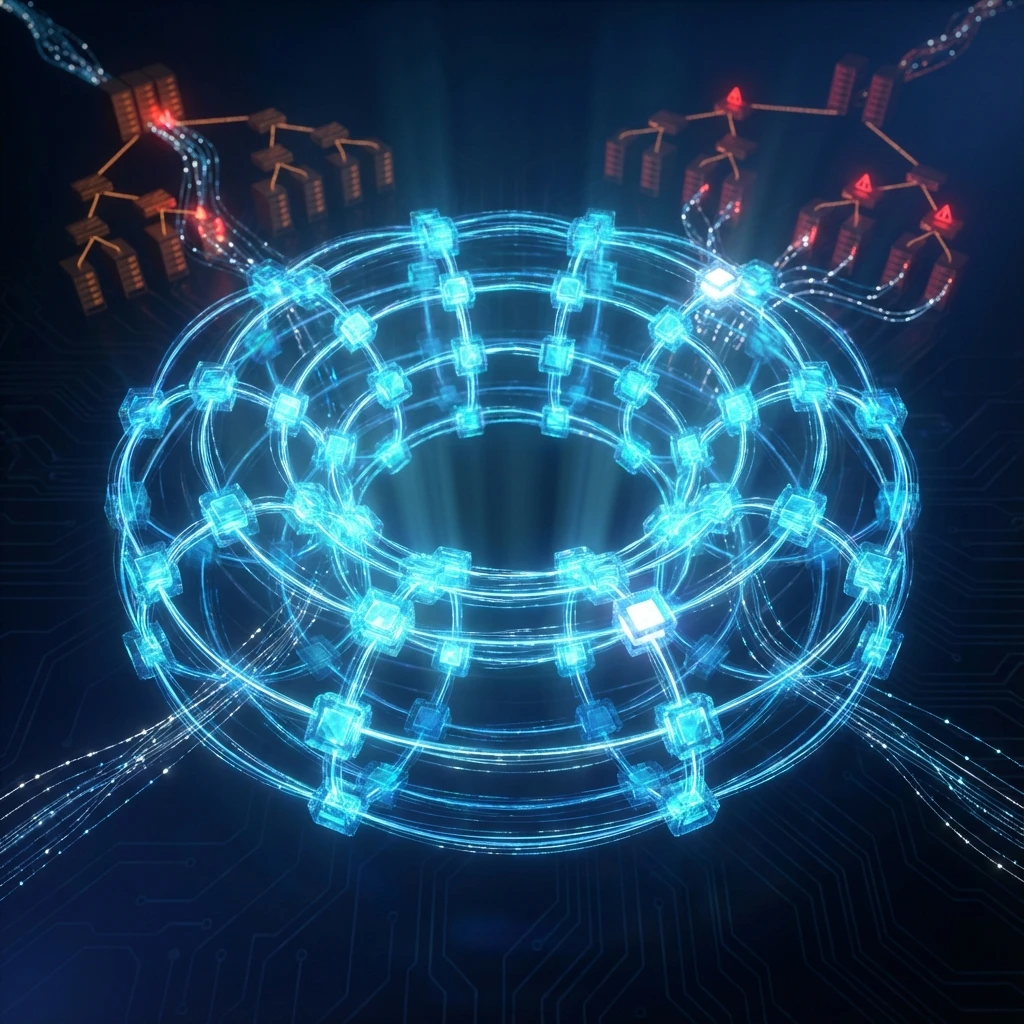
Table of Contents
- Executive Summary
- 1. The Architectural Paradigm: Sparse Mixture-of-Experts (MoE)
- 2. The Silicon Substrate: Google's TPU Advantage
- 3. The Economic Moat: The $191 Million Question
- 4. The Data Pipeline: "Robots.txt" and Synthetic Reality
- 5. Comparative Analysis: The Struggle for Silicon Independence
- 6. Future Outlook: The 2026 Inflection Point
- 7. Deep Dive: The Physics of Interconnects
- 8. The Human Element: Talent and Org Structure
- Conclusion
Executive Summary
The release of Gemini 3 Pro in November 2025 marks a definitive inflection point in the artificial intelligence landscape, not merely due to its benchmark performance, but because of the industrial strategy it reveals. While the public discourse focuses on context windows and reasoning capabilities, a rigorous analysis of the model card and underlying infrastructure exposes a more profound reality: Google has successfully decoupled model capacity from inference cost through a hardware-software co-design that competitors relying on merchant silicon cannot easily replicate.
The central thesis of this analysis is that the "AI Wars" have transitioned from a contest of model architecture to a contest of vertical integration. Gemini 3 Pro's architecture—a massive-scale Sparse Mixture-of-Experts (MoE)—is inextricably linked to the proprietary Tensor Processing Unit (TPU) v7 "Ironwood" on which it runs. This analysis demonstrates that the specific communication patterns required by Sparse MoE models are mathematically and physically optimized for the TPU's 3D torus interconnect topology, creating a distinct efficiency advantage over the hierarchical, switch-dependent networking used in NVIDIA GPU clusters.
By synthesizing technical specifications, pricing dynamics, and architectural disclosures, this document argues that Google's ability to train and serve frontier models at roughly one-fifth the cost of its competitors is not a temporary market fluctuation but a structural moat built over a decade. As OpenAI and Microsoft scramble to develop custom silicon (Project Titan, Project Stargate), they face a "hardware gap" of 3-5 years, during which they must subsidize the "NVIDIA tax"—the premium paid to the dominant GPU supplier—while Google operates on "house money," leveraging an infrastructure where the marginal cost of intelligence approaches zero.
1. The Architectural Paradigm: Sparse Mixture-of-Experts (MoE)
To understand the economic and strategic implications of Gemini 3 Pro, one must first dissect its architectural foundation. The industry has largely abandoned the monolithic dense transformer model for frontier-scale tasks, converging instead on Sparse Mixture-of-Experts (MoE). This shift is not merely an algorithmic preference; it is a response to the brutal physics of scaling laws.
1.1 From Dense to Sparse: The Computational Decoupling
In a traditional "dense" Large Language Model (LLM), such as the original GPT-3, every parameter in the neural network is activated for every single token processed. If a model has 175 billion parameters, a forward pass for the word "the" requires roughly 175 billion multiply-accumulate (MAC) operations. This creates a linear coupling between the model's "knowledge capacity" (parameter count) and its "inference cost" (FLOPs per token). This coupling becomes economically catastrophic at the trillion-parameter scale required for modern reasoning capabilities.
Gemini 3 Pro ruptures this coupling. As detailed in the November 2025 model card, Gemini 3 Pro utilizes a Sparse MoE transformer architecture. In this regime, the model's Feed-Forward Network (FFN) layers—which contain the bulk of the parameters and "knowledge"—are partitioned into distinct "experts." For any given input token, a "router" or "gating network" determines which experts are best suited to process that specific packet of information. If the model has 128 experts, the router might select only the top 2 (Top-k routing).
Consequently, while the total parameter count of Gemini 3 Pro may exceed several trillion (allowing it to store vast amounts of information, code repositories, and multimodal patterns), the active parameter count for generating a single token remains relatively small—likely in the range of 50–100 billion parameters.
This architectural shift represents a fundamental divergence in the economics of artificial intelligence. In a dense model, the cost of inference scales linearly with the intelligence of the model. To make a model twice as smart (doubling parameters), one must pay twice as much for every word it generates. Sparse MoE breaks this curve. It allows the model to become infinitely knowledgeable (by adding more experts) without increasing the cost of basic processing (by keeping the active parameter count static).
This is analogous to a library: a dense model forces you to read every book in the library to answer a question, while a sparse model allows you to consult only the relevant encyclopedia volume.
1.2 The Physics of Intelligence: Active vs. Total Parameters
The distinction between active and total parameters is not just an optimization; it is the key to achieving the capabilities users now expect, such as long-context reasoning and multimodal fluidity.
| Feature | Dense Model (Traditional) | Sparse MoE (Gemini 3 Pro) | Strategic Implication |
|---|---|---|---|
| Parameter Activation | 100% per token | ~1-10% per token | Decouples intelligence from cost |
| Training Compute | Linear with size | Sub-linear | Allows training larger models on same budget |
| Inference Latency | High (memory bound) | Low (compute efficient) | Enables faster output generation |
| Knowledge Capacity | Limited by FLOP budget | Massive | Can ingest/memorize vast corpora |
| Hardware Demand | High Compute Density | High Communication Bandwidth | Requires specialized interconnects |
The efficiency gains of Sparse MoE are not without trade-offs. While computational cost is reduced, the architecture introduces extreme demands on memory bandwidth and interconnect latency. Because the model must dynamically fetch parameters from different experts for every token, or route tokens to different chips where those experts reside, the system becomes bound by the speed of light and the bandwidth of copper or optical cables. This shifts the bottleneck from the Arithmetic Logic Unit (ALU) to the network switch.
1.3 The 1 Million Token Context and 64k Output
The model card highlights two critical specifications: a 1 million token context window and a 64,000 token output limit. These are not arbitrary numbers; they are direct byproducts of the MoE architecture's efficiency. A dense model attempting to attend to 1 million tokens would face catastrophic memory bottlenecks, as the massive weight matrices would compete with the Key-Value (KV) cache for High Bandwidth Memory (HBM).
Gemini 3 Pro, however, can ingest entire code repositories, hours of video, or hundreds of documents in a single prompt because its sparse nature preserves memory bandwidth for the context, rather than consuming it all on parameter weights. The 1 million token window essentially allows the model to hold a "working memory" equivalent to 10 full-length novels or a medium-sized enterprise codebase. This is not summarization; it is full-fidelity ingestion.
The 64k output limit—sufficient to generate a small book—demonstrates the model's inference stability. Maintaining coherence over such a long generation requires massive "thinking" or reasoning stability. In dense models, long outputs often degrade into hallucination or repetition as the attention mechanism gets diluted. The specialized "experts" in Gemini 3 Pro maintain state more effectively, allowing for the generation of complex, structured artifacts like complete software modules or legal briefs without loss of coherence.
1.4 The Routing Mechanism: The Hidden Bottleneck
The "magic" of MoE relies entirely on the routing mechanism. When a batch of tokens enters an MoE layer, the router scatters them to different experts. Expert A might handle syntax, Expert B handles Python code, and Expert C handles historical dates.
This creates a fundamental computer science problem: Dynamic Routing.
- Token Scattering: The system must physically move token data from the device hosting the Router to the device hosting Expert A.
- Computation: Expert A processes the token.
- Token Gathering: The system must move the result back to the main path for the next layer.
In a distributed training or inference cluster, these experts are spread across hundreds or thousands of chips. Therefore, every forward pass of the model triggers an explosion of data movement between chips. This phenomenon, known as "all-to-all" communication, is the Achilles' heel of MoE on standard hardware.
It is here that the divergence between NVIDIA GPUs and Google TPUs becomes the decisive factor in the AI arms race. On GPUs, this creates a communication nightmare; on TPUs, it is a solved problem.
2. The Silicon Substrate: Google's TPU Advantage
The assertion that "Gemini 3 Pro was trained entirely on TPUs" is not a marketing detail; it is the physical explanation for the model's existence. While NVIDIA GPUs are general-purpose parallel processors (GPGPUs) designed originally for graphics and adapted for AI, Google's TPUs are Application-Specific Integrated Circuits (ASICs) designed from the ground up for the specific linear algebra and networking patterns of neural networks.
2.1 TPU v7 "Ironwood": The Hardware for the Age of Inference
The infrastructure underpinning Gemini 3 Pro is the TPU v7, codenamed "Ironwood". Technical analysis of Ironwood reveals a chip optimized specifically to solve the MoE routing bottleneck. Unlike GPUs which must serve a broad market including gaming, crypto mining, and scientific simulation, the TPU is designed with a singular purpose: to run the matrix multiplications and vector operations of deep learning.
Technical Specifications of TPU v7 Ironwood:
- Performance: 4.6 petaFLOPS (FP8) per chip
- Memory: 192 GB HBM3e per chip
- Memory Bandwidth: 7.4 TB/s
- Interconnect: 4 × ICI (Inter-Chip Interconnect) links providing 9.6 Tbps aggregate bandwidth
While these numbers are impressive, they are roughly comparable to NVIDIA's Blackwell B200 on paper. The critical differentiator is not the raw FLOPS, but the Interconnect Topology and the efficiency of data movement. The TPU v7 delivers performance roughly matching NVIDIA's Blackwell but does so within a tightly integrated, vertically controlled ecosystem that optimizes for cost and scale rather than raw single-chip throughput.
2.2 The Topology War: 3D Torus vs. Fat Tree
The defining advantage of the TPU architecture for MoE models lies in its networking topology. This is where the physics of the datacenter dictates the economics of the model.
NVIDIA GPU Clusters (The Fat Tree / Clos Network):
NVIDIA clusters typically use a hierarchical network. GPUs within a server talk via NVLink/NVSwitch. To talk to a GPU in another server, traffic must pass through a Network Interface Card (NIC), up to a Top-of-Rack switch, and potentially through a "spine" switch via Infiniband or Ethernet (RoCE).
- Latency: Variable. Hops between switches add latency.
- Congestion: High. In an MoE "all-to-all" exchange, packets from thousands of GPUs flood the central spine switches simultaneously, causing "incast congestion" and tail latency.
- Efficiency: As noted in research on GShard (Google's early MoE work), communication overhead on standard networks can rise significantly, wasting compute cycles.
Google TPU Clusters (The 3D Torus):
TPUs are designed to be connected directly to their neighbors in a 3D Torus mesh. Chip A connects directly to Chip B (Up), Chip C (Down), Chip D (Left), etc., via dedicated ICI copper links. There are no external switches within the pod.
- Latency: Deterministic and ultra-low. Data moves chip-to-chip without protocol overhead.
- Congestion: The torus topology allows traffic to flow around the mesh.
- MoE Synergy: When Gemini 3 Pro routes tokens to experts, the data "hops" across the neighbor links. Because the bandwidth is massive (9.6 Tbps) and direct, the "all-to-all" shuffle happens efficiently.
Research confirms that communication overhead on TPUs for massive GShard-style models is contained at roughly 36%, whereas on non-optimized GPU clusters, the latency of routing can exceed the time spent computing, negating the benefits of MoE. This physical reality forces GPU users to adopt "dense" models or smaller MoE configurations, whereas Google can scale Gemini to thousands of experts seamlessly.
2.3 Power Efficiency and TCO
The TPU v7 Ironwood is reported to have a 2x performance-per-watt improvement over previous generations. In the context of "megawatt-scale" training runs, this efficiency translates directly to margin.
- Cooling: Ironwood is liquid-cooled and designed for high density.
- Power: By stripping out general-purpose graphics logic (rasterization, ray tracing units) found in GPUs, TPUs devote more silicon area to Matrix Multiply Units (MXUs) and local memory.
- Result: Google effectively pays a lower electricity bill for the same amount of "intelligence" produced.
The compounding advantage of this efficiency over a decade cannot be overstated. From TPU v4 (2020) to TPU v7 (2025), Google has achieved a cumulative 30x improvement in power efficiency. This creates a bifurcated market: Google operates in a regime of abundance, where it can afford to deploy massive MoE models for free consumer use, while competitors operate in a regime of scarcity, rationing compute and struggling to maintain positive gross margins.
3. The Economic Moat: The $191 Million Question
The divergence in hardware architecture creates a divergence in economics that is reshaping the competitive landscape. The "NVIDIA tax" is an existential threat to OpenAI and other competitors. The data supports this conclusion unequivocally.
3.1 Training Cost Disparity
The capital intensity of training frontier models has exploded. Estimates place the cost of training GPT-4 at roughly $78 million and Gemini Ultra at $191 million. While Gemini was more expensive in absolute terms due to its sheer scale and complexity, the efficiency of that spend is the key metric.
Google trains its models at cost. It owns the datacenters, the cooling, the racks, and the chips.
OpenAI, conversely, pays a markup at every layer:
- NVIDIA's Margin: NVIDIA commands gross margins of ~80% on H100/Blackwell chips.
- Microsoft's Margin: Azure charges a markup for cloud services to cover its own CapEx and operations.
Industry analysis suggests Google's internal cost for TPU compute is roughly 20% of what a comparable GPU instance costs a retail cloud customer. This implies that for every $100 OpenAI spends on compute, $80 is leaving the ecosystem as margin to NVIDIA and Microsoft, whereas Google retains that value or reinvests it. This structural disadvantage means OpenAI must achieve 5x the revenue per model just to reach parity with Google's unit economics.
3.2 The Inference Pricing War
This cost advantage is most visible in the aggressive pricing of Gemini 3 Pro.
- Gemini 3 Pro Preview: $2.00 / 1M input tokens
- OpenAI o3: Initially priced significantly higher ($10+), recently dropped to $2.00 to match
While OpenAI matched the price, the underlying economics differ fundamentally. For Google, $2.00 likely represents a healthy margin above their internal cost (thanks to TPUs). For OpenAI, dropping to $2.00 likely compresses their margin to near-zero or loss-leading levels, given they are paying the "NVIDIA tax" on the backend.
This is a classic war of attrition: Google is using its infrastructure advantage to bleed competitors who rely on merchant silicon.
3.3 The "House Money" Advantage
Google's cash stockpile and infrastructure ownership allow it to play a different game. By offering Gemini 3 Pro at essentially commodity prices, they commoditize the model layer, forcing value capture to move to the application layer (Google Workspace, Search, Android) or the infrastructure layer (Google Cloud)—both of which Google dominates.
Competitors who only sell the model (like Anthropic or OpenAI) are squeezed between high fixed costs (GPUs) and falling revenue per token (price war).
Furthermore, Google's "house money" extends to its ability to experiment. Training a $191 million model is a calculated risk for Google; for a startup, even a well-funded one, a failed training run of that magnitude is a catastrophe. This risk tolerance allows Google to pursue more radical architectures like massive sparse MoE, while competitors are forced to be more conservative, sticking to known-good dense architectures or smaller MoE configurations that fit within their tighter budgets.
4. The Data Pipeline: "Robots.txt" and Synthetic Reality
The Gemini 3 Pro model card reveals a sophisticated approach to the "data bottleneck." As the supply of high-quality human text on the web is exhausted, Google has pivoted to a hybrid data strategy that blends rigorous web compliance with massive-scale synthetic generation.
4.1 The Robots.txt Compliance and the New Social Contract
The model card explicitly mentions "honoring robots.txt". This is a strategic pivot. By rigorously adhering to web standards, Google aims to avoid the copyright litigations plaguing OpenAI and others. This compliance also serves as a gatekeeping mechanism: Google's dominant position in Search allows it to negotiate data access deals (like the Reddit partnership) that are unavailable to smaller players.
This adherence creates a "clean data" moat. While competitors scrape the web indiscriminately and face lawsuits that could force them to delete trained models (algorithmic disgorgement), Google's models are built on a legally defensible foundation. The "deduplication" and "quality checks" mentioned in the model card are standard, but executing them at Google's scale—filtering the entire index of the web—provides a signal-to-noise ratio that no other lab can match.
4.2 The Synthetic Data Feedback Loop
A critical revelation in the model card is the extensive use of "AI-generated synthetic data" and "RL data for multi-step reasoning". This suggests Google has solved the "model collapse" problem—where training on AI data degrades quality—by using a rigorous feedback loop.
- Reasoning Traces: Google is likely generating massive amounts of synthetic "Chain of Thought" data to train the routing networks and reasoning experts.
- Distillation: High-capacity experts generate training data for smaller, more efficient experts.
- Quality Filtering: The model card emphasizes "deduplication" and "quality checks." In an era of AI-generated web spam, Google's index gives it a unique advantage in discerning "high-quality" human data from low-quality bot spam, ensuring Gemini 3 Pro is trained on the "cleanest" slice of the internet.
This synthetic data pipeline is particularly crucial for the "reasoning" capabilities of Gemini 3 Pro. Human data on the web is often messy and lacks explicit logical steps. Synthetic data allows Google to create millions of perfect logic puzzles, coding challenges, and scientific proofs, training the model not just to predict the next word, but to follow a logical path. This explains the model's superior performance on benchmarks like Humanity's Last Exam and complex math evaluations.
5. Comparative Analysis: The Struggle for Silicon Independence
The market has recognized the TPU advantage, triggering a frantic race for custom silicon. The major cloud providers and AI labs are all attempting to replicate what Google started in 2015.
5.1 OpenAI's "Titan" and Broadcom
OpenAI, realizing its vulnerability, has partnered with Broadcom to build its own custom inference chip, likely named "Titan".
- Timeline: Expected late 2026 or 2027.
- Risk: This puts OpenAI 5-7 years behind Google's TPU roadmap (TPU v1 launched in 2015). By the time Titan launches, Google will likely be deploying TPU v8 or v9.
- Challenge: Designing the chip is only half the battle; building the software stack (compilers, kernels, networking drivers) to rival Google's XLA and JAX ecosystems is a monumental task that can take years to mature.
5.2 Microsoft's Project Stargate
Microsoft is planning a $500 billion "Stargate" supercomputer. While ambitious, current plans indicate heavy reliance on NVIDIA GPUs initially, transitioning to Microsoft's internal "Maia" chips later. This enormous capital expenditure highlights the desperation to escape the NVIDIA tax.
Microsoft is essentially trying to buy its way out of a strategic corner, but money cannot buy time. The operational expertise required to run a cluster of 100,000+ chips is something Google has been refining for a decade, while Microsoft is still learning the nuances of custom silicon at scale.
5.3 The Communication Barrier
Even if competitors build custom chips, they must solve the interconnect problem. NVIDIA's NVLink is proprietary and closed. Building a non-blocking, low-latency fabric like Google's 3D Torus requires not just chip design, but innovation in optical circuit switching (OCS) and datacenter topology—areas where Google has a decade of operational experience.
Google's OCS allows them to dynamically reconfigure the topology of the cluster to route around failures or optimize for specific model shapes, a capability that static GPU clusters lack.
6. Future Outlook: The 2026 Inflection Point
This analysis concludes that 2026 will be a decisive year. The trajectories of hardware efficiency and model scale are converging to a point where only vertically integrated players can survive at the frontier.
Cost Gap Widens: As Google scales TPU v7 Ironwood and introduces v8, the cost gap for serving sparse MoE models will widen. Google will be able to offer "intelligence too cheap to meter," integrated into Android and Workspace for free.
The "NVIDIA Tax" Becoming Existential: Startups and model labs paying NVIDIA margins will face a solvency crisis if they cannot differentiate their models significantly from Gemini's commoditized intelligence.
MoE Dominance: Sparse MoE will become the standard for all frontier models. Competitors stuck on dense architectures or inefficient GPU clusters will be unable to match the latency/cost profile of Gemini.
The Rise of Agentic AI: The low latency and massive context of Gemini 3 Pro enable "Agentic AI"—systems that can perform multi-step tasks autonomously. This requires stable, long-context reasoning, which is exactly what Gemini 3 Pro delivers. The 64k output limit is not just for writing books; it is for generating the internal monologue of an agent that plans, executes, and corrects its actions over thousands of steps.
7. Deep Dive: The Physics of Interconnects
To fully appreciate the TPU advantage, we must delve deeper into the physics of interconnects. The "all-to-all" communication pattern of MoE models is notoriously difficult to scale.
7.1 The Bandwidth-Latency Tradeoff
In network design, there is often a tradeoff between bandwidth (how much data you can move) and latency (how fast it starts moving).
- GPUs: Optimized for bandwidth via NVLink, but often struggle with the latency of multi-hop switching in large clusters.
- TPUs: Optimized for low-latency, deterministic routing via the 3D Torus.
The TPU v7's ICI links provide 9.6 Tbps of bandwidth per chip. While this is less than the theoretical peak of an NVIDIA NVLink switch, the effective bandwidth for MoE routing is higher because the torus topology matches the communication pattern of the algorithm. The "scatter-gather" operation of MoE maps perfectly onto the neighbor-to-neighbor links of the torus, minimizing congestion and maximizing utilization.
7.2 Optical Circuit Switching (OCS)
A key, often overlooked component of Google's infrastructure is Optical Circuit Switching (OCS). Introduced in TPU v4 and refined in v7, OCS allows Google to reconfigure the network topology on the fly using mirrors, rather than electrical switches.
- Fault Tolerance: If a rack fails, OCS can route around it instantly, preserving the torus topology.
- Topology Optimization: For different model shapes (e.g., a tall, thin model vs. a wide, shallow model), OCS can change the physical connections between racks to minimize the average hop count.
- Cost: Optical switches are cheaper and consume less power than electrical packet switches, further driving down TCO.
Competitors using standard Infiniband or Ethernet switches do not have this flexibility. They are stuck with a static topology that is often over-provisioned (expensive) or under-provisioned (slow). Google's OCS is a secret weapon that allows them to run their datacenters at higher utilization rates than anyone else.
8. The Human Element: Talent and Org Structure
Finally, one cannot ignore the organizational structure that enables this integration. Google DeepMind (the model builders) and the Google Brain/TPU teams (the hardware builders) operate in a tight feedback loop.
Co-Design: The model team requests specific operations (e.g., efficient sparse scatter-gather), and the hardware team implements instructions in the next TPU generation to accelerate them.
Software Stack: The JAX and XLA (Accelerated Linear Algebra) software stack is the bridge. Unlike CUDA, which is a general-purpose language, XLA is a domain-specific compiler that "sees" the entire computation graph and optimizes it for the TPU hardware.
Competitor Friction: OpenAI must wait for NVIDIA to release a chip, then figure out how to optimize their code for it. They are customers, not architects. This friction slows down innovation cycles.
Gemini 3 Pro is the result of this seamless integration. It is a system where the boundaries between hardware, software, and model architecture have dissolved, creating a unified machine for intelligence.
Conclusion
Gemini 3 Pro is not just a model; it is the software manifestation of a hardware empire. By betting on TPUs and Sparse MoE a decade ago, Google has constructed a vertical fortress. While the world watches the benchmark scores, the real war is being won in the datacenter, where the physics of the TPU torus topology and the economics of zero-margin silicon are creating an unassailable advantage.
The AI race is no longer about who has the smartest algorithm; it is about who owns the silicon that makes that algorithm affordable. Google's victory with Gemini 3 Pro was written in the silicon of the TPU v1 back in 2015; the rest of the industry is just now reading the results.
This is the "Silicon Sovereignty" that Google has achieved, and it is the standard against which all future AI systems will be measured.
Note: This analysis is based on available technical disclosures, model cards, and industry reports as of November 2025. Technical specifications for proprietary hardware like TPU v7 and NVIDIA B200 are based on published benchmarks and architectural whitepapers.
#AI #machineLearning #AIInfrastructure #generativeAI #Innovation #BusinessStrategy

About Ryan Wentzel
Ryan previously served as a PCI Professional Forensic Investigator (PFI) of record for 3 of the top 10 largest data breaches in history. With over two decades of experience in cybersecurity, digital forensics, and executive leadership, he has served Fortune 500 companies and government agencies worldwide.
Related Articles
Taming the LLM: Using Finite-State Machines to Prevent Hallucinations in AI Workflows
Hallucinations are not a prompt problem—they are an architecture problem. Here is how wrapping LLM calls in a Finite-State Machine transforms a probabilistic model into a predictable, inspectable software component you can ship to paying customers.
6 Min. ReadRead more →
Embracing the Cycle: A Pragmatic Look at TDD in Ruby on Rails
How Red–Green–Refactor keeps SaaS codebases shippable as they scale — and why pragmatic TDD pays compounding dividends for Rails teams.
5 Min. ReadRead more →
The Algorithmic Trust Paradox: How iOS 26 and FinanceKit Are Rewiring Fintech After the AI Hallucination Crisis
How Apple Intelligence hallucinations exposed fragile market microstructure, and why iOS 26's Liquid Glass UI and FinanceKit API are fundamentally reshaping fintech data provenance, algorithmic trading, and the death of screen scraping.
6 Min. ReadRead more →