Loading…
Debugging the Lithosphere: How AI is Refactoring Geothermal Energy in the Nevada Basin
By Ryan Wentzel
8 Min. Read#AI#geothermal#machine-learning#clean-energy#physics-informed-neural-networks
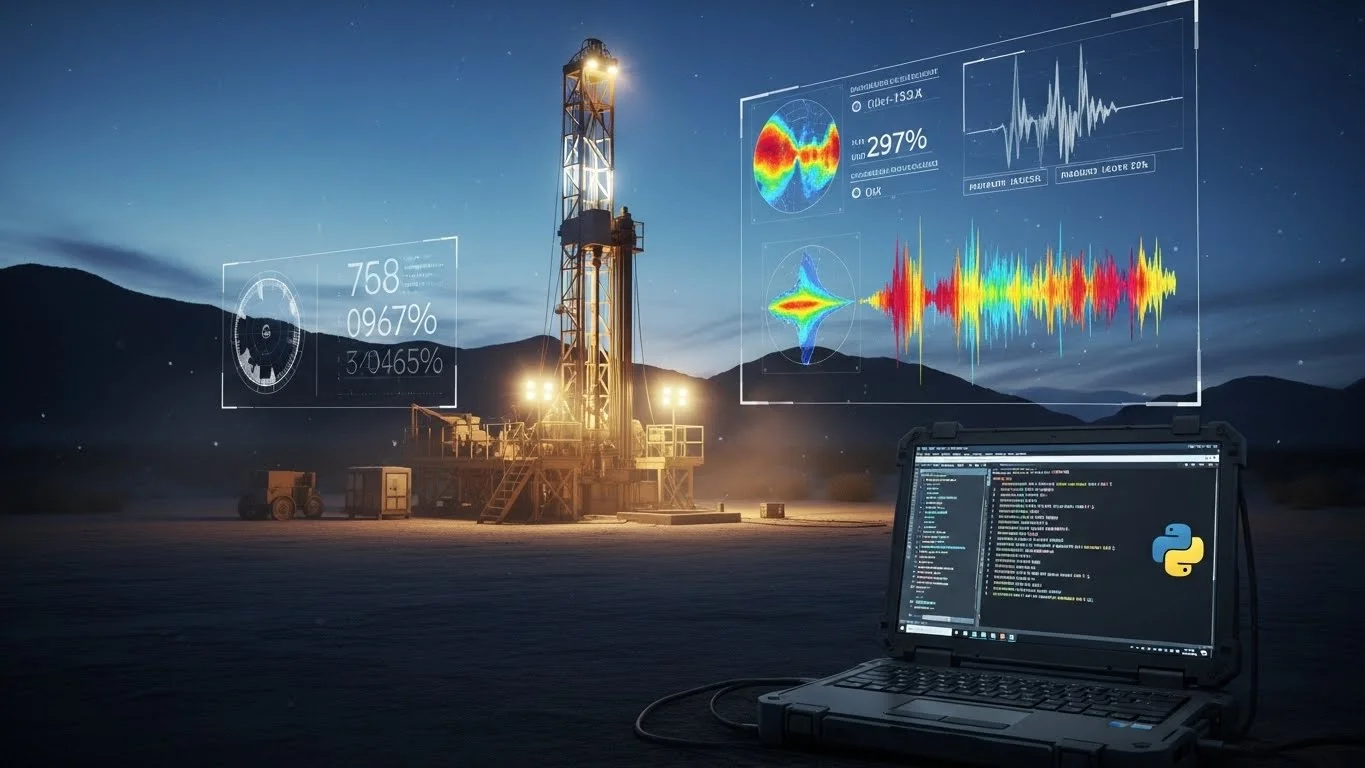
Table of Contents
- I. The Dataset Beneath Our Feet: Reframing the Subsurface Problem
- II. The Inference Engine: Zanskar and Stochastic Prospecting
- III. The Control Loop: Fervo Energy and Real-Time Edge Computing
- IV. The Recursion: AI Powering AI
- V. From Hunting to Farming: The Managed Lithosphere
- VI. The Road Ahead: Challenges and Implications
I. The Dataset Beneath Our Feet: Reframing the Subsurface Problem
To a geologist, the Nevada desert is a Basin and Range province characterized by crustal thinning. To an AI engineer, it is a noisy, high-dimensional dataset with a massive missing data problem.
For decades, geothermal energy—potentially the holy grail of baseload carbon-free energy—has been stalled by a lack of "visibility." We could only drill where we saw steam (fumaroles), leaving the vast majority of the resource "blind" to human detection. In late 2025, that changed. Two distinct algorithmic approaches—one probabilistic and one deterministic—converged in the Nevada desert to unlock gigawatts of potential power.
The core challenge of geothermal exploration is fundamentally an inference problem. The Earth's crust is opaque to direct observation. We have sparse surface measurements, fragmented historical drilling logs, and incomplete seismic surveys. Traditional exploration methods relied on human intuition to correlate visible surface features—hot springs, steam vents, and altered rock—with the invisible subsurface structures that contain exploitable heat.
This approach had a critical flaw: it could only find resources that advertised themselves. The "blind" resources, those with no surface manifestation, remained hidden. And according to recent estimates, these blind systems may represent the majority of the total geothermal resource base.
Here is the technical breakdown of how Zanskar and Fervo Energy are using diverse ML architectures to solve the subsurface inference problem.
II. The Inference Engine: Zanskar and Stochastic Prospecting
Zanskar's recent discovery of the "Big Blind" system—a massive, hidden resource with no surface manifestation—is a validation of physics-informed machine learning applied to sparse datasets.
The Problem: High-Bias, Low-Throughput Exploration
Traditional exploration relies on human intuition to correlate surface features with subsurface permeability. A geologist examines field data, consults historical records, and makes an educated guess about where to drill. This approach is high-bias (constrained by human cognitive limitations and historical precedent) and low-throughput (limited by the number of expert hours available).
The "dry hole" problem has historically terrified investors. A single exploratory well can cost millions of dollars, and the success rate for wildcat drilling in unproven areas has been notoriously poor. This capital risk has been the primary barrier to scaling geothermal development.
The Stack: Treating the Crust as a Probabilistic Volume
Zanskar treats the Earth's crust not as a deterministic system to be mapped, but as a probabilistic volume to be sampled. Their proprietary platform, GeoCore, utilizes SQL-based feature engineering indexed on H3 hexagonal grids to manage vast geospatial datasets. This hexagonal indexing system provides a consistent spatial framework for integrating heterogeneous data sources: gravity surveys, magnetic anomalies, thermal gradient measurements, geological maps, and historical drilling records.
The key insight is that each of these data sources provides a partial, noisy view of the subsurface. No single measurement type is sufficient, but their combination—weighted by uncertainty and constrained by physical laws—can generate a coherent probability distribution.
The Architecture: Bayesian Uncertainty with Physics-Informed Neural Networks
Zanskar's approach integrates Bayesian uncertainty quantification with physics-informed neural networks (PINNs). This is not a simple pattern-matching exercise. The model must respect the underlying physics of heat transfer, fluid flow, and rock mechanics.
The training strategy is elegant in its simplicity:
- Positive labels: Known geothermal fields where commercial production has been established
- Negative labels: Historical dry holes where drilling failed to find exploitable resources
By training on this labeled dataset, the model learns to discriminate between geological configurations that produce heat and permeability versus those that do not. The Bayesian framework provides not just a point estimate, but a full probability distribution—allowing the company to quantify confidence and manage risk.
The Result: Finding What Humans Missed
The model successfully identified a 250°F reservoir at only 2,700 feet depth at the Big Blind site—a shallow, high-enthalpy target that previous deterministic methods had missed completely. This depth is remarkably shallow for a high-temperature resource, making it economically attractive for development.
The "Big Blind" discovery proves a fundamental point: synthetic intelligence can uncover natural resources that biological intelligence overlooked. The resource was always there, but human pattern-matching failed to find it because it lacked the surface signatures that humans were trained to look for.
This effectively turns exploration into a stochastic optimization task, reducing the "dry hole" risk that has historically terrified investors. Instead of betting on individual wells, investors can now evaluate a portfolio of probabilistic targets with quantified uncertainty bounds.
III. The Control Loop: Fervo Energy and Real-Time Edge Computing
If Zanskar is using AI to find the resource, Fervo Energy is using AI to engineer it. Fervo's "Cape Station" project is scaling Enhanced Geothermal Systems (EGS) by adapting horizontal drilling techniques from oil and gas. The challenge here isn't location; it's optimization of the fracture network.
EGS works by creating artificial permeability in hot, dry rock. Water is injected into one well, flows through engineered fractures in the rock, absorbs heat, and returns to the surface through a production well. The efficiency of this system depends entirely on the geometry and connectivity of the fracture network.
The Sensor Layer: Distributed Acoustic Sensing
Fervo deploys Distributed Acoustic Sensing (DAS) fiber optics inside the wellbore. This turns kilometers of fiber into a continuous array of microphones, generating terabytes of raw interferometric data. The fiber detects tiny strain changes caused by acoustic waves propagating through the rock—including the micro-seismic events that occur when fractures propagate.
This is not traditional seismology. Traditional seismometers are discrete sensors with limited spatial coverage. DAS provides continuous spatial sampling at meter-scale resolution, but at the cost of generating massive data volumes that cannot be processed by human analysts.
The Model: DASEventNet and Real-Time Classification
Processing this noise floor to detect micro-seismicity (rock cracking) in real-time is beyond human capacity. Fervo employs DASEventNet, a deep learning model based on ResNet (Residual Neural Network) architectures.
ResNet architectures are well-suited for this task because they can learn hierarchical features from raw waveform data. The model learns to distinguish the spectral and temporal characteristics of genuine micro-earthquakes from the background noise of pumping equipment, surface traffic, and natural seismicity.
Performance: Superhuman Detection Accuracy
DASEventNet achieved 100% accuracy in discriminating micro-earthquakes (MEQs) from background noise in test sets, identifying over 5,700 events where traditional algorithms (like Short-Term Average/Long-Term Average, or STA/LTA) detected only 1,307.
This is not a marginal improvement. The AI model detected more than four times as many events as the industry-standard algorithm. Each detected event provides information about where fractures are propagating, how they are oriented, and how they are interconnected.
The Application: Real-Time Flow Profiling
This allows for real-time flow profiling. By analyzing the spectral signature of fluid moving through fractures, the system can detect "short circuits"—pathways where cold water moves too fast through preferential channels, reducing heat extraction efficiency.
When a short circuit is detected, the system can optimize injection rates dynamically. This is a closed-loop control system: sense the fracture network state, model the flow dynamics, and adjust the operating parameters to maximize heat extraction. The Earth's crust becomes a manageable, tunable system rather than a static resource to be exploited.
IV. The Recursion: AI Powering AI
The most elegant aspect of this development is the feedback loop. The primary offtaker for these new geothermal projects is Google, driven by the massive power demands of its own data centers.
We are witnessing a symbiotic recursion:
-
Compute demand spikes: Training and inference for large AI models requires enormous amounts of electricity, often from data centers that operate 24/7.
-
AI optimizes extraction: Zanskar's physics-informed neural networks identify new resources; Fervo's ResNet-based models optimize heat extraction from engineered reservoirs.
-
Geothermal provides firm power: Unlike solar and wind, geothermal energy is dispatchable and available around the clock—exactly what data centers need.
This is not merely a pleasant coincidence. It represents a fundamental shift in how we think about energy infrastructure for the AI era. The same machine learning techniques that drive compute demand are being deployed to solve the energy supply problem.
V. From Hunting to Farming: The Managed Lithosphere
The historical model of resource extraction has been "hunting"—searching for concentrated deposits that nature happened to create. Geothermal has been no different: find the hot spring, drill nearby, and hope for the best.
EGS represents a shift to "farming"—creating the conditions for heat extraction wherever the thermal gradient is favorable. The Earth's crust is hot everywhere below a certain depth. The question is not whether heat exists, but whether we can economically access it.
AI changes both sides of this equation:
- On the finding side: Probabilistic models reduce exploration risk, making it economical to drill in areas that human intuition would have dismissed.
- On the engineering side: Real-time optimization models increase extraction efficiency, improving the economics of marginal resources.
The "Big Blind" discovery proves that we can use synthetic intelligence to uncover natural resources that biological intelligence overlooked. As we move from "hunting" for heat to "farming" it with EGS, the Earth's crust effectively becomes a manageable, dispatchable asset in our energy stack.
VI. The Road Ahead: Challenges and Implications
This convergence of AI and geothermal is not without challenges. The models require training data, and geothermal drilling data is historically sparse and proprietary. The physics-informed approaches help constrain the solution space, but more data will be needed to improve model generalization.
The real-time control systems also raise questions about reliability and safety. EGS operations can induce felt seismicity if not managed carefully. AI models that optimize for heat extraction must also incorporate constraints on induced seismic risk—a multi-objective optimization problem that is still being refined.
But the trajectory is clear. The same algorithmic techniques that are transforming finance, healthcare, and logistics are now being applied to the oldest energy source on Earth. And unlike fossil fuels, this resource is effectively inexhaustible on human timescales.
The lithosphere has been debugged. The refactoring is underway.
#AI #geothermal #cleanEnergy #machineLearning #EGS #Nevada #sustainableEnergy #energyTransition

About Ryan Wentzel
Ryan previously served as a PCI Professional Forensic Investigator (PFI) of record for 3 of the top 10 largest data breaches in history. With over two decades of experience in cybersecurity, digital forensics, and executive leadership, he has served Fortune 500 companies and government agencies worldwide.
Related Articles

Taming the LLM: Using Finite-State Machines to Prevent Hallucinations in AI Workflows
Hallucinations are not a prompt problem—they are an architecture problem. Here is how wrapping LLM calls in a Finite-State Machine transforms a probabilistic model into a predictable, inspectable software component you can ship to paying customers.
6 Min. ReadRead more →
Embracing the Cycle: A Pragmatic Look at TDD in Ruby on Rails
How Red–Green–Refactor keeps SaaS codebases shippable as they scale — and why pragmatic TDD pays compounding dividends for Rails teams.
5 Min. ReadRead more →
The Algorithmic Trust Paradox: How iOS 26 and FinanceKit Are Rewiring Fintech After the AI Hallucination Crisis
How Apple Intelligence hallucinations exposed fragile market microstructure, and why iOS 26's Liquid Glass UI and FinanceKit API are fundamentally reshaping fintech data provenance, algorithmic trading, and the death of screen scraping.
6 Min. ReadRead more →