Loading…
The Physics of Pollination: Why High-Yield Walnut Orchards Are Switching to Dry Electrostatics
By Ryan Wentzel
7 Min. Read#agriculture#walnuts#pollination#precision-agriculture#orchard-management
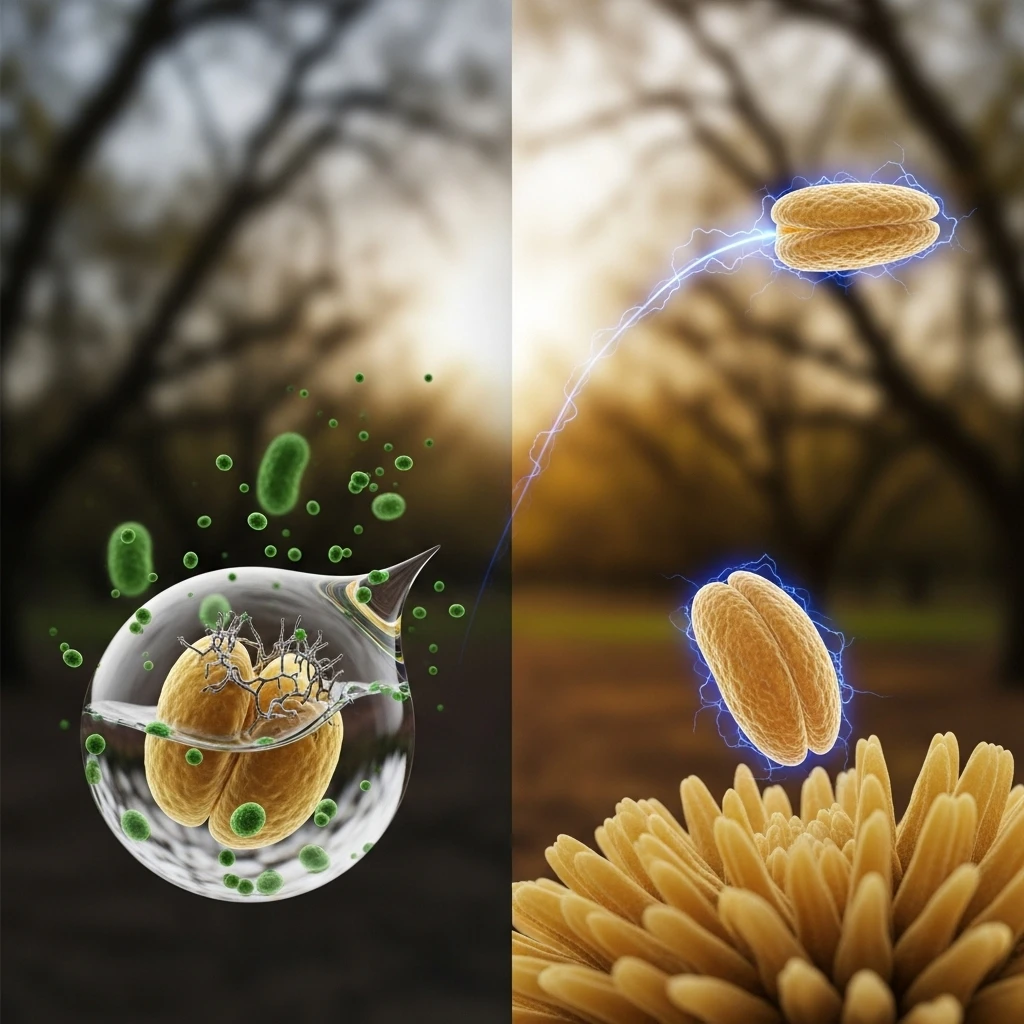
Table of Contents
- The Settlement Sheet Reality: Managing at the Physiological Ceiling
- The Biological Failure Mode: Osmotic Shock and Bacterial Vectors
- The Physics Solution: Electrostatic Wrap-Around
- The Carrier Protocol: Lycopodium Spores
- The Physiology Limit: Pistillate Flower Abscission
- The Economic Model: Yield Stabilization
- Conclusion: Precision Over Volume
The Settlement Sheet Reality: Managing at the Physiological Ceiling
If you are managing a mature 'Chandler' block in the Central Valley, you know the reality of the Settlement Sheet. Looking at the production data for a prime 8th-leaf orchard, we see a yield of 5,000 lbs per acre fetching $1.20 per pound. That generates a gross revenue of $6,000 per acre.
At this elite level of production, your trees are operating near their physiological ceiling. The game is no longer about "more inputs" or chasing volume; it is about risk mitigation and stabilization. The biggest uncontrolled variable remaining in your orchard is the timing mismatch between pollen shed (staminate bloom) and flower receptivity (pistillate bloom)—a phenomenon known as dichogamy.
For years, the industry attempted to bridge this gap with liquid pollen sprays. Ag-tech startups promised that mixing pollen with "nutrient slurries" was the future. They were wrong. From a plant physiology and physics perspective, liquid pollination is a fundamentally flawed approach for walnuts.
Here is the technical deep dive on why high-performance growers are pivoting to Dry Electrostatic Dusting—specifically utilizing the Progressive Ag LectroBlast—and why it is the only viable method for protecting your $6,000/acre asset.
The Biological Failure Mode: Osmotic Shock and Bacterial Vectors
To understand why dry application is superior, we must first understand why liquid application fails at the cellular level.
The Osmotic Pressure Problem
Walnut pollen (Juglans regia) is anemophilous (wind-loving). It has evolved to travel in a desiccated, metabolically dormant state with a moisture content of roughly 4–8%. It is designed to rehydrate slowly and exclusively upon contact with the stigma's specific exudate.
When you introduce a walnut pollen grain into a spray tank—even one amended with sucrose and boron—you subject it to immediate hypotonic stress. Water rushes across the semi-permeable plasma membrane faster than the cytoplasm can adjust. This leads to two catastrophic failure modes:
- Lysis: The pollen grain bursts due to rapid turgor pressure increase, destroying the cell.
- Premature Germination: The pollen tube ejects inside the tank. Once the pollen tube emerges, the grain is incredibly fragile. The shear forces of passing through a hydraulic nozzle at 150+ PSI will shred the tube, rendering the pollen sterile before it ever leaves the machine.
Dry application maintains metabolic stasis. The pollen grain remains dormant and protected by its exine (outer shell) until it physically lands on the stigma. Germination is triggered only by the biological interface with the flower, not by the water in your tank.
The Pathological Risk: Xanthomonas
Walnut Blight (Xanthomonas arboricola pv. juglandis) is a motile bacterium that requires free moisture to infect. It swims. By spraying a liquid suspension into the canopy during bloom (Class 3/Class 4 pistillate stage), you are essentially creating an artificial rain event. If the liquid contains sugar (often added to "feed" the pollen), you are spraying a bacterial growth medium directly onto the most susceptible tissue of the tree.
Dry dusting is sterile. It introduces zero moisture to the canopy. It breaks the disease triangle by removing the environmental vector (water) required for blight infection.
The Physics Solution: Electrostatic Wrap-Around
If dry pollen is biologically superior, why hasn't it been the standard? Because dry pollen is light. Without the mass of a water droplet, gravity-based dusting relies on wind, which is inefficient. Most of the pollen blows through the orchard or lands on the ground.
The solution is found in Coulomb's Law:
$$F = k_e \frac{q_1 q_2}{r^2}$$
This is where the Progressive Ag LectroBlast becomes the critical piece of hardware. It does not rely on gravity; it relies on electromagnetism.
How It Works
-
Induction Charging: As the dry pollen/carrier mix exits the air-shear nozzle, it passes through a high-voltage induction ring (typically ~10kV). This strips electrons, imparting a strong negative charge to every particle in the cloud.
-
Image Charge Attraction: Your walnut trees are rooted in the earth, making them electrically grounded (neutral/positive relative to the cloud).
-
The Wrap-Around Effect: As the negative pollen cloud approaches a branch, it doesn't just fly in a straight line (ballistic trajectory). It follows the electric field lines which curve around the target. Pollen grains will literally reverse direction in mid-air to adhere to the back of the nutlet or the stigma hidden inside a spur.
The Efficiency Delta
Standard gravity dusting requires ~100g of pollen/acre to ensure contact. Electrostatic deposition is 3x–5x more efficient, allowing you to drop the rate to 20g/acre.
This is not just about saving pollen cost—it is about avoiding the physiological damage that over-pollination can cause.
The Carrier Protocol: Lycopodium Spores
You cannot run 20 grams of pure pollen through a tractor-mounted blower; the volume is too low to meter accurately. You need a carrier that matches the aerodynamics of the walnut pollen.
The industry standard is Lycopodium clavatum spores (Club Moss).
Why Lycopodium?
Aerodynamic Diameter: Walnut pollen grains are approx. 30–40 microns. Lycopodium spores are approx. 30 microns. This size match prevents "separation" in the airstream. If you used a heavier carrier (like flour or talc), the carrier would fly further than the pollen, ruining your distribution.
Hydrophobicity: Like walnut pollen, Lycopodium repels water, keeping the mix flowable and preventing clumping in the hopper.
The Mix: A 1:20 ratio (1 part Pollen : 20 parts Carrier) provides the bulk density needed for the LectroBlast to meter the flow accurately.
The Physiology Limit: Pistillate Flower Abscission
In high-vigor orchards like the one in your data (5,000 lbs/acre), "more" is not better. It is dangerous.
Walnuts have a unique self-regulation mechanism called Pistillate Flower Abscission (PFA). If a female flower receives too much pollen, the rapid germination of hundreds of pollen tubes triggers a massive release of ethylene (a stress hormone). The tree reacts to this shock by aborting the flower entirely.
This is why the LectroBlast's precision is non-negotiable.
- A standard duster creates "hot spots" of pollen that can trigger PFA and reduce your yield.
- The LectroBlast creates a uniform, charged fog. By calibrating for exactly 20 grams of active pollen per acre, you deposit just enough grains (10–15 per stigma) to ensure fertilization without triggering the ethylene abortion response.
The Economic Model: Yield Stabilization
Using your actuals from the settlement sheet, here is how the math works for a high-production block:
Baseline Yield: 5,000 lbs/acre
Price: $1.20/lb
Gross Revenue: $6,000/acre
The Cost of Precision
To do this right, you cannot use cheap "bee pollen." You must use certified pure pollen.
- Material: 20g Pure Pollen ($50) + Carrier ($5) ≈ $55.00/acre
- Application: Machinery & Labor (LectroBlast Operation) ≈ $50.00/acre
- Total Input Cost: $105.00 per acre
The Break-Even
At $1.20/lb, you need to save 88 lbs of nuts per acre to pay for the application. That is a mere 1.75% yield recovery.
The ROI of "Filling the Gap"
In a dichogamous year (where male/female bloom don't overlap), you might lose 5–10% of your crop to lack of pollination.
- Recovering just 5% yield (250 lbs) = $300 in protected revenue.
- Net Profit: $300 - $105 = $195.00 per acre.
On a 100-acre block, this technology acts as a $19,500 insurance policy. It doesn't need to create a bumper crop (which risks quality/sizing); it simply ensures you don't have a failure year due to timing.
Conclusion: Precision Over Volume
Stop spraying water on your trees during bloom. The biology doesn't support it, and the pathology risks are too high.
By moving to dry electrostatic dusting with the Progressive Ag LectroBlast, you align the physics of deposition with the biology of the walnut flower, securing your yield with surgical precision.
Key Takeaways:
- Liquid pollen fails due to osmotic shock, premature germination, and disease risk.
- Electrostatic physics delivers pollen with 3–5x greater efficiency than gravity-based methods.
- Lycopodium carrier ensures aerodynamic matching and uniform distribution.
- Precision prevents PFA: Over-pollination triggers flower abortion; electrostatics delivers the optimal dose.
- Economic protection: For $105/acre, you insure against 5–10% yield loss in dichogamous years.
For high-yield orchards operating at their physiological ceiling, this is not optional technology—it is the new standard for risk management.
#agriculture #walnuts #pollination #precisionAgriculture #orchardManagement #plantPhysiology #agriculturalTechnology #electrostatics #cropScience #yieldOptimization

About Ryan Wentzel
Ryan previously served as a PCI Professional Forensic Investigator (PFI) of record for 3 of the top 10 largest data breaches in history. With over two decades of experience in cybersecurity, digital forensics, and executive leadership, he has served Fortune 500 companies and government agencies worldwide.
Related Articles

The Living Mirror: How Digital Twins Are Hacking the Soil Microbiome
A technical deep dive into Soil Digital Twins—the convergence of edge computing, GAN-based microbiome simulation, and real-time sensor fusion that is shifting agriculture from reactive precision to predictive regeneration.
8 Min. ReadRead more →

The Strategic Imperative for a Domestic Shift to Walnuts: A Comprehensive Analysis of Nutritional, Economic, and Environmental Advantages over Almonds
A comprehensive analysis examining why the United States should pivot from almonds to walnuts—addressing public health deficits through Omega-3 fatty acids, environmental sustainability, and economic sovereignty.
20 Min. ReadRead more →